
Ethernet Cable Buying Guide: Cat5e, Cat6, Cat6a, Cat7 and Cat8
An Ethernet cable is the physical twisted-pair copper link used to connect network switches, routers, computers, IP cameras, wireless access points and other devices into a structured wired network. Buyers usually compare Ethernet cable by its category name, such as Cat5e, Cat6, Cat6a, Cat7 or Cat8, but the full specification also includes shielding construction, conductor type, jacket material and fire rating.
Linoya Electronic Technology Co., Ltd., a cable and wire manufacturer established in 1997, integrates R&D, manufacturing and sales in intelligent transmission, smart power and new materials. The company supplies a full Ethernet cable portfolio from Cat5e to Cat8, including U/UTP, F/UTP, SF/UTP, U/FTP and F/FTP constructions with solid bare copper conductors and PVC or LSZH jacket options.

Why Ethernet Cable Selection Is More Than a Category Name
Several failures in a network are caused by cable specification mistakes rather than by switches or routers. Typical symptoms include no link light, intermittent disconnection, slow speed, random packet loss, unstable PoE power supply, or a link that negotiates at 100 Mbps instead of the expected gigabit speed. In many cases the cause is physical damage, poor termination, wrong cable grade for the distance, incorrect shielding for the electromagnetic environment, or the use of low-quality conductors.
An Ethernet cable decision therefore depends on more than bandwidth. The buyer also needs to answer:
- What speed and distance must the permanent link support?
- Will the cable run beside motors, power lines or other high-interference sources?
- Does the installation area require indoor, in-wall, plenum, riser, outdoor or direct-burial construction?
- Does the project require PoE, PoE+ or PoE++ power delivery?
- Which certificates are accepted by local authorities or the project tender?
Industry Background: Ethernet Cable Demand and Standards
Global demand for Ethernet cable continues to grow with enterprise networks, data centers, security systems, smart-building infrastructure and industrial automation. According to Maximize Market Research, the global Ethernet cable market was valued at USD 38.55 billion in 2025 and is expected to reach nearly USD 70.02 billion by 2032, with a CAGR of 8.9% from 2026 to 2032.
Within the product mix, Cat6 represented the largest category segment in 2025, accounting for 32.5% of the Ethernet cable assembly market, according to Dataintelo. That position reflects the balance Cat6 offers between cost, installation familiarity and the ability to support gigabit networks with headroom for short-distance 10G links.
Standards also continue to evolve. ANSI/TIA-568.2-E was released in October 2024, replacing ANSI/TIA-568.2-D, and introduced DC resistance unbalance (DCRU) specifications for Cat5e, Cat6 and Cat6A cabling. Buyers and installers should therefore check whether a project specification refers to the revised TIA standard or to an earlier cable-performance reference.
Detailed Solution: Understanding the Ethernet Cable Family
Linoya builds its Ethernet cable range with solid bare copper conductors, LDPE insulation, and either PVC or LSZH jackets. Solid bare copper provides stable conductivity and dependable PoE performance. The portfolio is organized around the transmission distance and speed a link must support.
Cat5e Ethernet Cable: Gigabit for General Networks
Cat5e is the entry performance grade for structured cabling and security camera networks. It supports 1 Gbps over ordinary 100-meter horizontal runs, with enough performance for most office LANs, SMB networks and PoE cameras. Linoya supplies multiple Cat5e versions so the installation team can match the shielding level to the environment.
Cat5e U/UTP is an unshielded cable designed for residential, commercial office, IP surveillance and SMB networking. Cat5e F/UTP adds an overall foil shield for offices or small commercial buildings with minor electromagnetic interference. Cat5e SF/UTP adds a screen plus foil overall shield for commercial buildings, industrial edges and high-noise office environments. Each Cat5e model in the Linoya series uses 24AWG solid bare copper and carries UL/ETL certification with a CM/CMG flame rating.
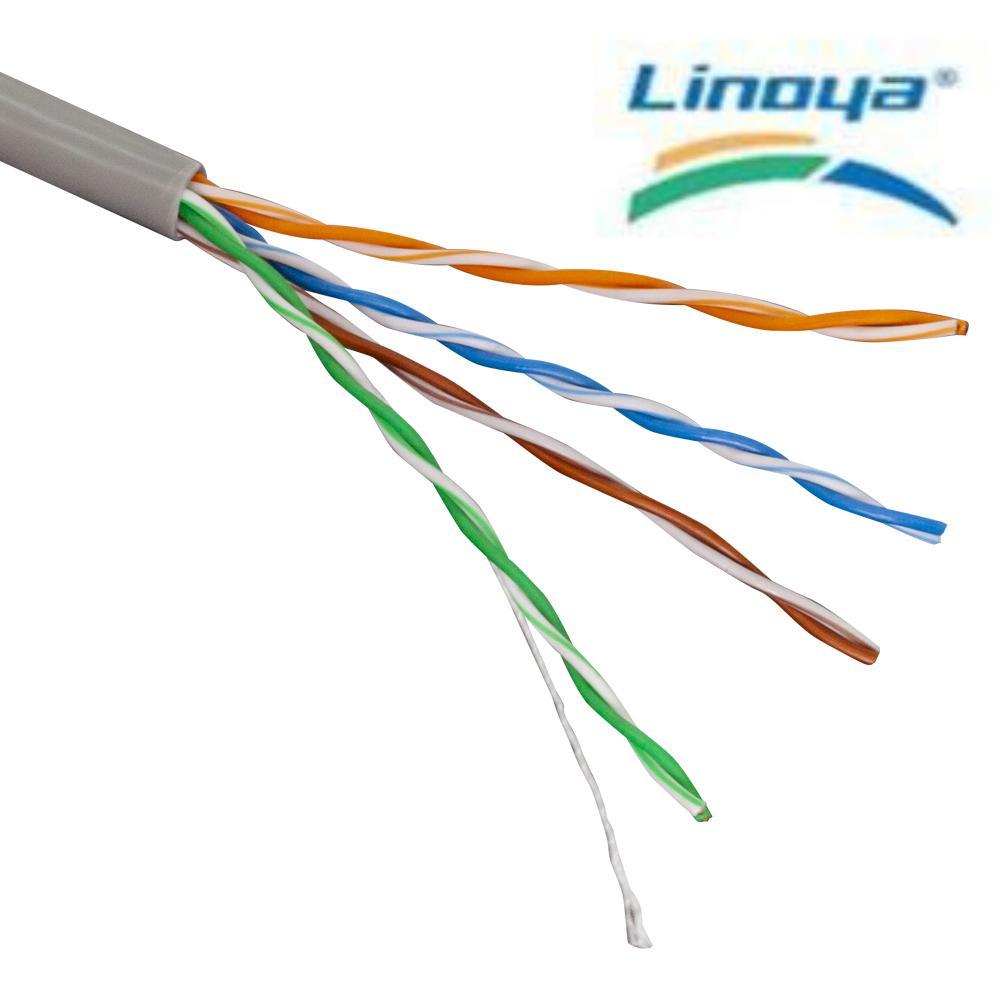
Cat6 Ethernet Cable: Ten-Gigabit Up To 55 Meters
Cat6 provides a higher performance level than Cat5e. It is designed for gigabit networks and for short-range 10Gbps links up to 55 meters. In high-bandwidth applications, Cat6 is a practical upgrade path for offices and data centers where cable runs are relatively short.
Linoya offers Cat6 in U/UTP, F/UTP and SF/UTP constructions. The Cat6 U/UTP model provides dual 24AWG or 23AWG solid bare copper conductor options, supports 10Gbps up to 55 meters and is suitable for commercial offices, home networking, IP surveillance and small-to-medium business environments. Cat6 F/UTP adds an overall foil shield for offices with EMI and surveillance systems. Cat6 SF/UTP adds a screen-plus-foil overall shield for commercial buildings, industrial automation and enterprise networks. The Cat6 series is UL/ETL certified with a CMR flame rating.
Cat6a Ethernet Cable: Full-Distance 10G and PoE++ Readiness
Cat6a is the cable grade selected when 10Gbps must be stable over the full 100-meter channel. Cat6a also provides better alien-crosstalk control, which is important in dense cable bundles, and is often preferred for PoE++ high-power applications.
Linoya Cat6a models are available as U/UTP, U/FTP, SF/UTP and F/FTP variants. The 23AWG solid bare copper conductors support 10Gbps at 100 meters. For enterprise data centers and server rooms, the individual-pair foil construction of Cat6a U/FTP reduces crosstalk between pairs. For heavy-EMI industrial sites, the full-shield Cat6a F/FTP provides additional protection against interference. Cat6a models are specified with CMP flame rating and UL/ETL/CPR certification where the product data sheet and certificate scope confirm the exact variant.
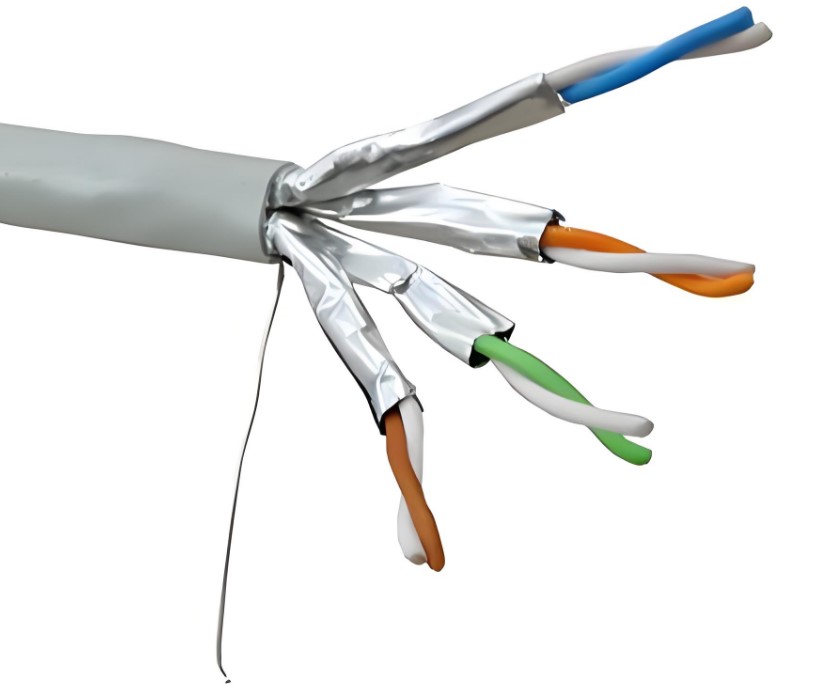
Cat7 and Cat7a Ethernet Cable: High-Speed Shielded Links
Cat7 and Cat7a are used when a project needs higher bandwidth headroom and stronger shielding. Cat7 F/FTP in the Linoya range uses 23AWG solid bare copper conductors and supports 40Gbps at 50 meters with overall and pair full foil shielding. Cat7a F/FTP uses 22AWG solid bare copper and supports 100Gbps at 15 meters with lower conductor resistance for short ultra-high-speed links.
These grades are designed for high-EMI industrial environments, premium data centers and high-performance networking. Because they are fully shielded, correct grounding is important. Linoya specifies CMP flame rating and UL/ETL/CPR certification for these models.
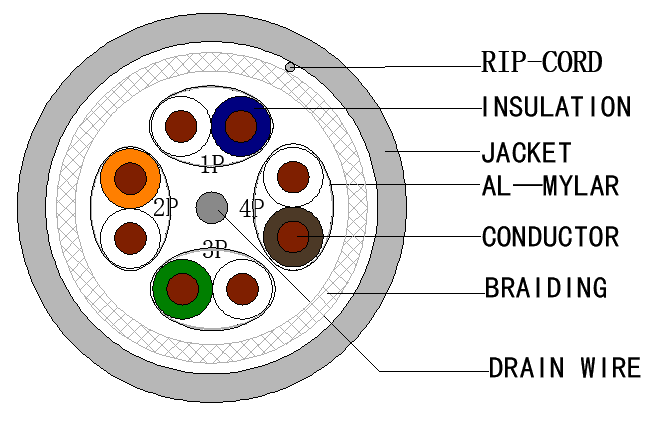
Cat8 Ethernet Cable: Short-Range Data Center Interconnect
Cat8 is a specialized high-frequency grade for short data center links. Linoya CAT8 F/FTP supports 40Gbps at 30 meters using 22AWG solid copper and an overall-plus-pair foil shield. The cable is designed for switch-to-server and cabinet-to-cabinet connections in data centers, cloud infrastructure and enterprise networks.
Cat8 provides strict shielding and crosstalk control at high frequencies, but its useful transmission distance is shorter than that of Cat6a or Cat7. Buyers should choose Cat8 only when the channel length and high-speed requirement match the short-reach design target.
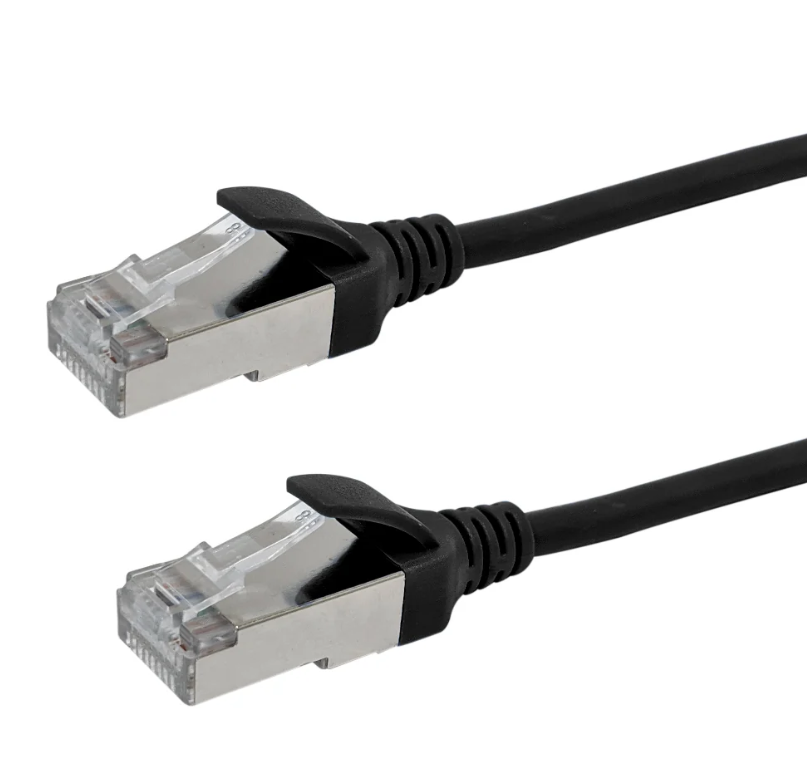
Shielding Types: UTP, FTP, SF/UTP and Full-Shield Constructions
Shielding defines how the cable resists electromagnetic interference from the surrounding environment.
UTP (U/UTP) has no metal shielding layer. It is lower in cost, easy to terminate and suitable for low-interference residential, office and SMB environments.
F/UTP, often called FTP, uses an overall foil shield. It provides protection against moderate electromagnetic interference and keeps the cable relatively flexible.
SF/UTP combines a wire screen and an overall foil shield. It provides stronger anti-EMI/RFI performance and is used for industrial edges, commercial buildings and high-noise environments.
U/FTP applies foil shielding around each twisted pair rather than only around the whole cable. This construction reduces pair-to-pair crosstalk and suits enterprise data centers and high-performance 10G networks.
F/FTP or S/FTP provides both overall shielding and pair shielding. Full-shield cables are used for heavy-EMI industrial sites, data centers and 40G/100G-class short links. Shielded cable must be installed with proper grounding to perform correctly.
Jacket, Fire Rating and CPR Considerations
Jacket material affects fire safety more than transmission speed. A PVC jacket is lower in cost and has good physical wear resistance, but it produces denser smoke and halogen gases when burned. An LSZH jacket is designed to produce low smoke and no corrosive halogen gas in a fire, which is why LSZH is normally specified for hospitals, hotels, subway stations and other crowded public buildings.
In Europe, Ethernet cable for construction projects must comply with the Construction Products Regulation (CPR) and carry a fire-reaction class issued by an EU Notified Body. In North America, cable fire ratings are expressed as CM/CMG, CMR or CMP. CM/CMG is suitable for general commercial use in many non-plenum areas, CMR is intended for riser installations, and CMP is required for plenum air-handling spaces. A plenum project generally cannot be satisfied with CM or CMG cable.
Linoya supplies Ethernet cable with PVC or LSZH jackets across the Cat5e to Cat8 range. The actual CPR class, UL file status and ETL verified scope should be confirmed for the exact model before an order is placed, because certification statements cover specific constructions and markets.
Conductor Choice: Solid Copper and Why It Matters
Conductor quality has a direct effect on signal stability and PoE performance. Copper-clad aluminum, often called CCA, uses an aluminum core with a thin copper coating. CCA is cheaper but has higher resistance, weaker PoE performance and a higher oxidation risk. It is not recommended for permanent commercial or industrial installations.
Solid bare copper Ethernet cable provides lower DC resistance, more stable signal transmission and dependable PoE power delivery. For fixed horizontal cabling in walls, ceilings and raceways, solid-conductor cable is normally required. Stranded-conductor cable is more flexible and is commonly used for patch cords, but it is not designed for long-distance fixed horizontal runs.
Linoya's Ethernet cable models in the Cat5e, Cat6, Cat6a, Cat7 and Cat8 ranges use solid bare copper conductors. Conductor sizes vary by category, including 24AWG, 23AWG and 22AWG, allowing the cable to balance transmission distance and resistance.
Step-by-Step Ethernet Cable Selection Process
The following framework helps buyers move from a network requirement to a practical cable specification.
- Define the required speed and run distance. Cat5e is the practical choice for 1Gbps horizontal channels. Cat6 supports 10Gbps up to 55 meters. Cat6a supports 10Gbps over the full 100-meter channel. Cat7 F/FTP supports 40Gbps at 50 meters, Cat7a F/FTP supports 100Gbps at 15 meters, and Cat8 F/FTP supports 40Gbps at 30 meters.
- Check the installation environment. Identify whether the cable will run indoors, in-wall, in a plenum or riser, outdoors, or directly buried. Indoor cable is not suitable for open-air exposure because it lacks UV and water resistance. Outdoor aerial cable is reinforced for overhead installation, while direct-burial cable uses a structure designed to resist underground moisture and soil corrosion.
- Match the shielding type to the noise level. Use UTP in quiet environments, F/UTP or FTP in areas with moderate EMI, and SF/UTP, U/FTP or full-shield F/FTP constructions for high-EMI industrial sites and high-speed links.
- Apply fire-safety requirements. Select PVC for general indoor use where code allows, choose LSZH for public buildings with smoke and halogen limits, and match CM/CMG, CMR or CMP to the North American installation space. For EU projects, verify the CPR fire class required by the tender.
- Confirm conductor and certification scope. Choose solid bare copper for permanent horizontal cabling. Before ordering, check whether the certification document covers the exact model and construction. For North America, verify a valid UL file or ETL Verified report. For Europe, verify a CPR-CE certificate issued by a Notified Body.
- Plan the bulk cable format. Horizontal structured cabling is usually installed from bulk cable on reels or in pull boxes. For multi-drop floors, bulk Ethernet cable is the normal format; 305 m, or 1,000 ft, is a widely used bulk-box length in North American projects. Buyers should state the exact distance per run, total quantity, jacket material and certification requirement when requesting a quotation.
Use Cases for Different Ethernet Cable Grades
IP Surveillance and SMB Networking
Security camera installations often combine data and PoE power over one cable. Cat5e U/UTP is a cost-effective baseline for gigabit links and standard PoE cameras, while Cat5e F/UTP or SF/UTP adds protection where cameras are mounted near electrical noise. Linoya Cat5e models are available with CM/CMG flame ratings for indoor structured cabling and security camera systems.
Commercial Building and In-Wall Networks
Office buildings usually need permanent horizontal cabling that supports current and future bandwidth. Cat6 U/UTP is a practical choice for gigabit networks with short 10G headroom, while Cat6a is used when 10G must run the full 100 meters. For public-building projects in Europe, LSZH jackets and CPR compliance are often mandatory. Linoya also supplies LSZH-jacketed Cat6a and Cat7 variants; the Cat6A U/FTP LSZH model, for example, is referenced with CPR Dca-s1,d0,a2 in the company's certification documentation.
Data Center Short-Reach Interconnect
Data center operators need predictable high-speed links between switches, servers, storage devices and patch panels. Cat6a supports stable 10G links at 100 meters. Cat7 and Cat8 provide higher speed headroom for short cabinet-to-cabinet connections. Linoya specifies Cat8 F/FTP for 40Gbps up to 30 meters and Cat7a F/FTP for 100Gbps up to 15 meters, using 22AWG conductors with full shielding.
Industrial Networks and High-EMI Floors
Factory floors with motors, welders, VFDs and automation equipment generate electromagnetic noise that can disturb unshielded cable. Fully shielded Cat6a F/FTP or Cat7 F/FTP constructions are more appropriate for these locations. Linoya Cat6a F/FTP and Cat7 F/FTP are intended for high-EMI industrial environments, data centers and high-performance networking, where signal stability under continuous operation is critical.
Comparison: Linoya Ethernet Cable Family at a Glance
The following table compares representative Linoya bulk Ethernet cable models. It is a reference for product planning, not a substitute for the project-specific link budget or certificate check.
| Category / Model | Shielding construction | Conductor | Rated performance | Flame / certification notes |
|---|---|---|---|---|
| Cat5e U/UTP | Unshielded | 24AWG solid bare copper | 1 Gbps | CM/CMG, UL/ETL |
| Cat5e F/UTP | Overall foil shield | 24AWG solid bare copper | 1 Gbps | CM/CMG, UL/ETL |
| Cat5e SF/UTP | Screen plus foil overall shield | 24AWG solid bare copper | 1 Gbps | CM/CMG, UL/ETL |
| Cat6 U/UTP | Unshielded | 24AWG or 23AWG solid bare copper | 10 Gbps up to 55 m | CMR, UL/ETL |
| Cat6 F/UTP | Overall foil shield | 24AWG or 23AWG solid bare copper | 10 Gbps up to 55 m | CMR, UL/ETL |
| Cat6 SF/UTP | Screen plus foil overall shield | 24AWG or 23AWG solid bare copper | 10 Gbps up to 55 m | CMR, UL/ETL |
| Cat6a U/UTP | Unshielded | 23AWG solid bare copper | 10 Gbps at 100 m | CMP, UL/ETL/CPR per model scope |
| Cat6a U/FTP | Individual pair foil shield | 23AWG solid bare copper | 10 Gbps at 100 m | CMP, UL/ETL/CPR per model scope |
| Cat6a SF/UTP | Screen plus foil overall shield | 23AWG solid bare copper | 10 Gbps at 100 m | CMP, UL/ETL/CPR per model scope |
| Cat6a F/FTP | Overall plus pair foil shield | 23AWG solid bare copper | 10 Gbps at 100 m | CMP, UL/ETL/CPR per model scope |
| Cat7 F/FTP | Overall plus pair foil shield | 23AWG solid bare copper | 40 Gbps at 50 m | CMP, UL/ETL/CPR |
| Cat7a F/FTP | Overall plus pair foil shield | 22AWG solid bare copper | 100 Gbps at 15 m | CMP, UL/ETL/CPR |
| Cat8 F/FTP | Overall plus pair foil shield | 22AWG solid bare copper | 40 Gbps at 30 m | CMP, UL/ETL/CPR |
Certification notes above reflect the product specification fields supplied by Linoya. Buyers should confirm the exact certificate scope, model number and jacket material with the manufacturer before ordering.
Frequently Asked Questions
What Ethernet cable certifications should be checked for North American and EU projects?
North American projects generally require a valid UL Mark or ETL Verified certification together with the correct flame rating. EU construction projects require CPR-CE certification issued by an EU Notified Body. Linoya supplies Cat5e to Cat7 series cables with UL, ETL and CPR approvals and also lists UL/ETL/CPR coverage on higher-speed models such as Cat8. Because certification covers specific models and constructions, the buyer should confirm the certificate scope for the exact part number.
How do I choose between Cat5e, Cat6 and Cat6a Ethernet cable?
Cat5e is a practical solution when the network needs 1 Gbps. Cat6 is used when short-range 10Gbps links within 55 meters are required. Cat6a is selected when 10Gbps must be stable over a full 100-meter channel, when cable bundles are dense, or when PoE++ and future-proofing are important. Cat6a has stricter alien-crosstalk performance than Cat6 and normally has a larger cable diameter and higher project cost.
UTP, FTP and SF/UTP: which shielding type should I use?
UTP is suitable for low-interference environments. F/UTP, often called FTP, is used for moderate electromagnetic interference. SF/UTP offers stronger protection where EMI/RFI is more severe. For full-shield performance, Linoya also supplies U/FTP, F/FTP and S/FTP-style constructions. Shielded cables need reliable grounding during installation; unshielded cable does not require grounding but is more exposed to interference.
LSZH or PVC jacket: which one is right for a public building?
Public buildings such as hospitals, hotels and subway stations normally require LSZH low-smoke zero-halogen cable because it reduces smoke and halogen gas in a fire. PVC jacket cable is lower in cost and more flexible, but cannot achieve the high CPR fire class needed for many public-building tenders. Linoya offers Cat6A U/FTP LSZH cable with CPR Dca-s1,d0,a2 certification for European public-building applications.
How can I confirm the right Linoya Ethernet cable before ordering?
Send your project speed, distance, environment, jacket and certification requirements to Linoya. The company can recommend the correct category and construction, and provide data sheets and certification scope for the exact model. For product information, contact Linoya Electronic Technology Co., Ltd. by email at inquiry@linoya.com, by phone at +86-15602610696, or by WhatsApp at +86-13038893260.
Conclusion
Ethernet cable remains the backbone of physical network connectivity. For most procurement decisions, the starting point is the speed and distance target: Cat5e covers 1 Gbps, Cat6 covers short-distance 10G, Cat6a covers full-distance 10G, and Cat7, Cat7a and Cat8 address high-speed shielded and short-reach links. The next step is matching shielding, jacket, flame rating and conductor quality to the installation code and electromagnetic environment.
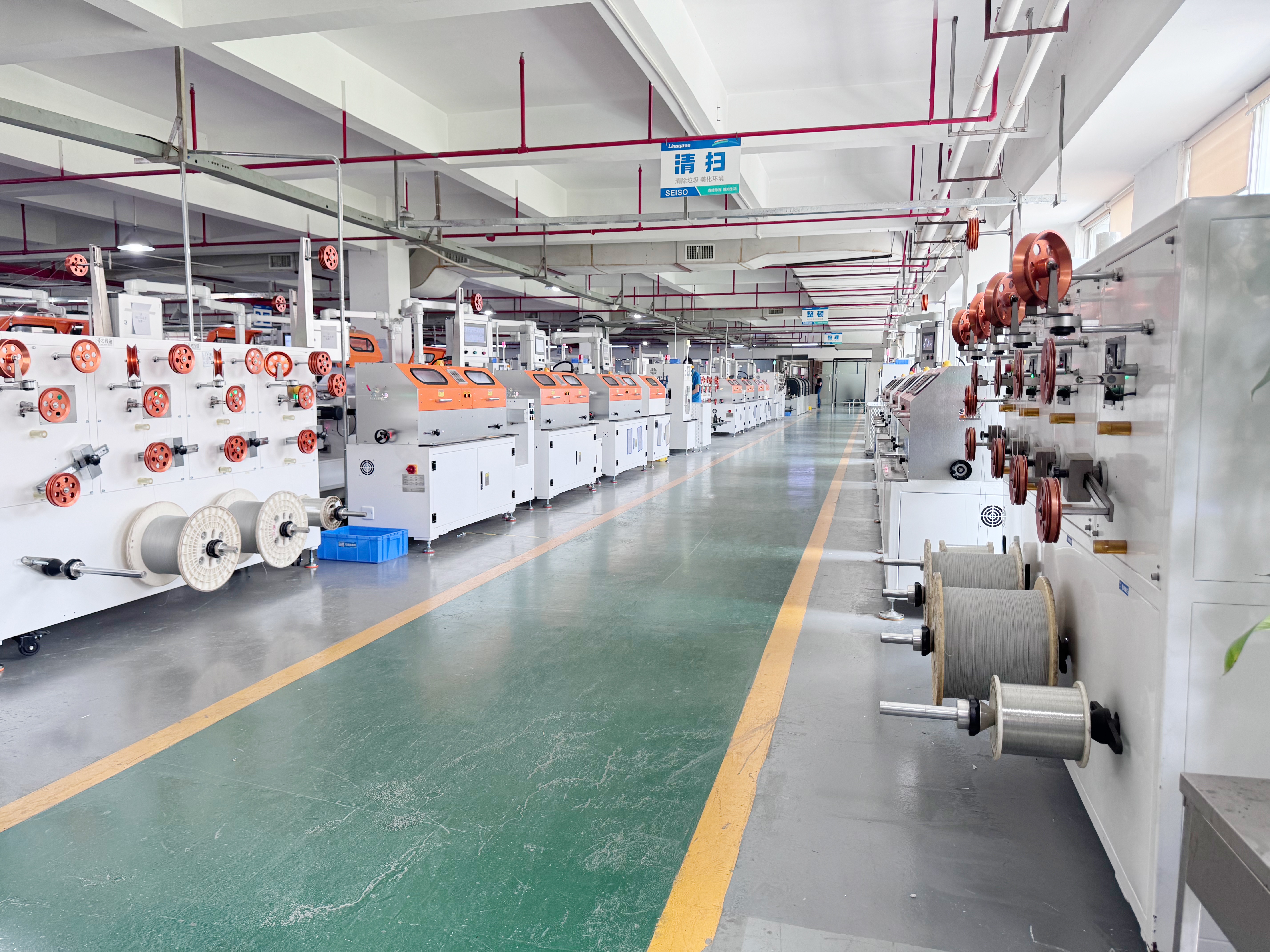
Linoya Electronic Technology Co., Ltd. provides a broad Cat5e, Cat6, Cat6a, Cat7, Cat7a and Cat8 Ethernet cable range manufactured in a company with three self-owned industrial parks in Shenzhen and Dongguan, one production base in Vietnam, and about 3,000 employees including more than 300 R&D engineers.
Ready to Define Your Ethernet Cable Specification?
When a project needs a certified, solid-conductor cable with the correct shielding and jacket, Linoya can support category selection, technical documentation and certification verification.
Download the Linoya Electronic Technology brochure (PDF) or visit the Linoya website for the full product range.
Email: inquiry@linoya.com · Phone: +86-15602610696 · WhatsApp: +86-13038893260
Have Questions or Need More Details?
Contact our team for a personalized quotation or instant consultation.
Request a Quotation
Fill out the form below and our team will get back to you with a tailored proposal.
WhatsApp Direct Chat
Prefer to chat in real-time? Message us on WhatsApp for instant assistance & quick answers.
- Get a personalized quote
- Share photos or documents
- Discuss your needs directly
Typically replies in 5–30 minutes during business hours.