
Ethernet Cable Partnership FAQ: Long-Term Supply, Acceptance Criteria and After-Sales Support
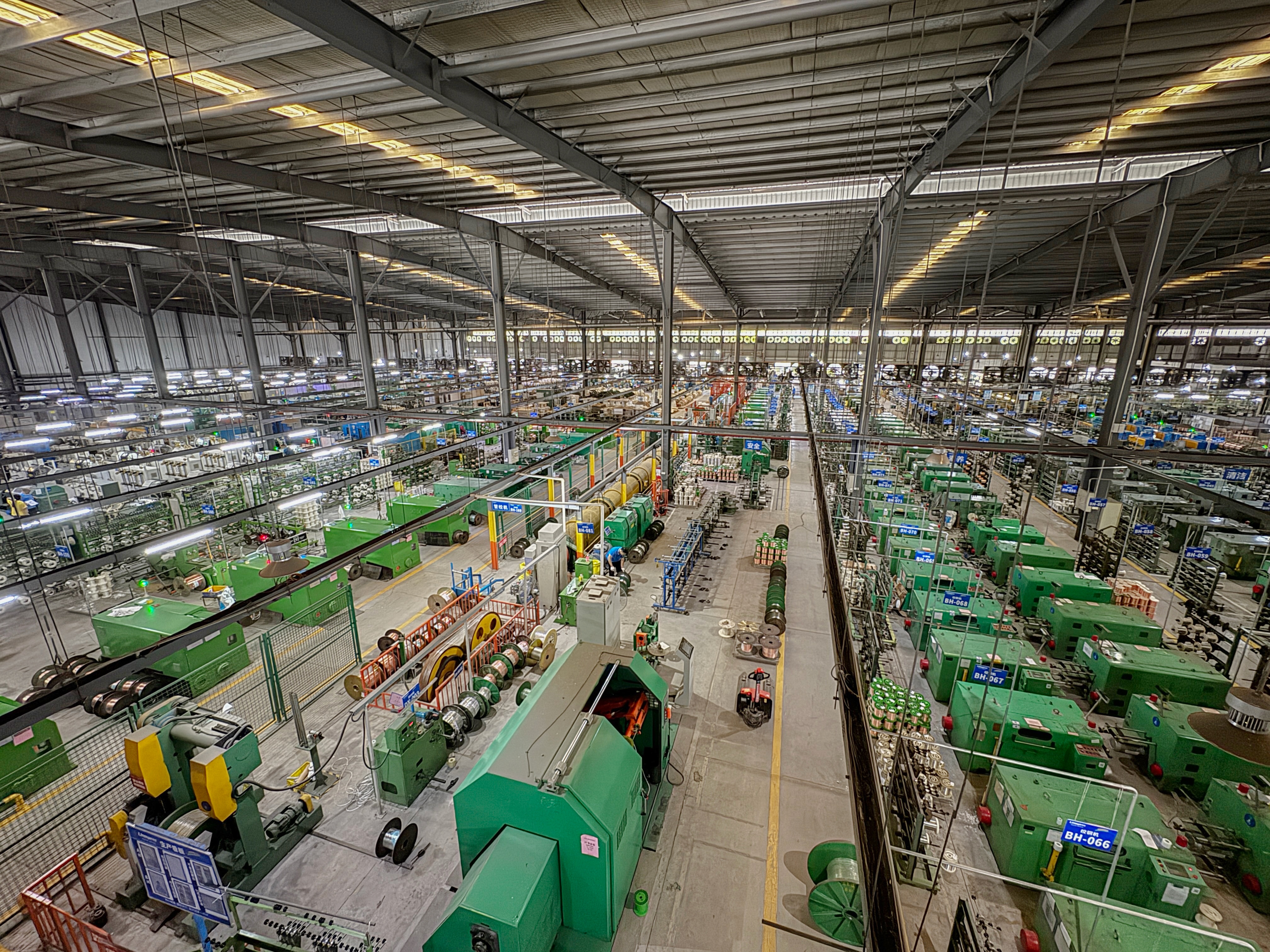
Conductor stranding on a tubular strander — the first step that determines whether a bulk Ethernet cable order will pass acceptance testing months later.
A long-term Ethernet cable partnership works when three things are fixed in writing before the first bulk order: purchasing terms with measurable acceptance criteria, a test method that both buyer and supplier accept, and an after-sales commitment matched to the actual deployment. Everything else — price negotiation, packaging design, delivery scheduling — sits on top of those three agreements.
Linoya Electronic Technology Co., Ltd. is a cable and wire manufacturer established in 1997, operating three self-owned industrial parks in Shenzhen and Dongguan, China, plus a production base in Vietnam. The company produces network cables and high-speed data transmission cables across Cat5e, Cat6, Cat6A, Cat7, Cat7A and Cat8 constructions, and maintains UL, ETL and CPR certification records for its communication/LAN cable lines.
This FAQ is written for buyers in the research and evaluation stage: the product category is already understood, and the remaining question is whether a specific supplier can carry a rolling annual order without creating compliance, quality or service exposure.
Problem Definition: What Actually Breaks a Long-Term Cable Partnership
Most cable supply relationships that fail do not fail because the cable is bad on day one. They fail because the buyer and supplier never agreed on what “correct” means, and the first disputed shipment exposes it.
- Category shorthand hides construction. A purchase order that says only “Cat6” does not state whether the cable is U/UTP, F/UTP or SF/UTP, nor whether the conductor is 23AWG or 24AWG. Both 24AWG/23AWG options exist inside Linoya’s Cat6 range, and they are not interchangeable in a tender document.
- Certificate scope does not match order scope. Certificates name specific models and standards. An ETL verified certificate may cover a Cat5e UTP CM horizontal cable under a stated part number, while a UL Certificate of Compliance may cover CM, CMG, CMR and CMP types under UL 444. A CPR classification report is typically valid only for the cable type described in that report.
- No agreed test method. If the contract does not say who tests, with what instrument, at what length and against which limit, a site dispute has no resolution path.
- Conductor substitution. Copper-clad aluminium conductor and off-spec cable grade are documented causes of link failure, low throughput and unstable PoE power supply — and they are invisible until the cable is terminated and energised.
- After-sales left undefined. “Full support” is not a service level. Replacement terms, warranty duration and technical response channels must be named.
The practical conclusion: an Ethernet cable supply partnership should be evaluated as a documentation and process problem, not only as a product specification problem.
Industry Background: Why Cable Procurement Is Also a Documentation Exercise
Twisted-pair Ethernet has a hard physical limit. The standard sets 100 metres as the maximum total channel length including patch cords; beyond that, signal attenuation and packet loss appear and a repeater or switch is required rather than a longer single run. Every commercial discussion about category, conductor size and price ultimately sits inside that 100-metre envelope.
Inside the envelope, performance is tiered. Cat5e is specified for 1 Gbps. Cat6 reaches 10 Gbps up to 55 metres. Cat6a holds 10 Gbps across the full 100 metres. Above that, Cat7 supports 40 Gbps at 50 metres, Cat7a reaches 100 Gbps at 15 metres, and Cat8 carries 40 Gbps at 30 metres — all as documented in the respective product datasheets.
Two separate fire-safety systems govern where a cable may legally be installed:
- North America: UL 444 and CSA C22.2 No. 214-08 define the CM, CMG, CMR and CMP types. Linoya’s UL Certificate of Compliance E320763 covers communications cable types CM, CMG, CMR and CMP rated 60°C or 75°C.
- Europe: EN 50575 and EN 13501-6 define CPR reaction-to-fire classes. Linoya’s file includes Eca classifications for Cat5e and Cat6 constructions, Dca-s1a,d0,a2 and Dca-s1,d1,a2 classifications for LSZH Cat6A and Cat6 constructions, and a B2ca-s1a,d0,a1 Certificate of Constancy of Performance for Cat6/6A/7/7A/8 S/FTP communication/LAN cables.
Power delivery adds a third variable. PoE and PoE++ loads up to 90 W concentrate heat inside bundled cables, which is why conductor gauge, jacket material and bundle density have to be decided together rather than at the last minute.
Detailed Solution: The Three Agreements Behind a Workable Supply Partnership
1. Purchasing Terms and Acceptance Criteria That Survive an Audit
Acceptance criteria are the clauses that let a receiving inspector say yes or no without negotiating. For Ethernet cable, a workable clause set covers:
- Product designation and construction: category plus shielding (for example CAT6A U/UTP or CAT6 F/UTP), conductor gauge, insulation and jacket material. Linoya’s constructions use solid bare copper conductor, LDPE insulation and PVC or LSZH jacket.
- Transmission target: rate and distance, written as a number — 10 Gbps at 100 m for Cat6A, 10 Gbps at 55 m for Cat6, 1 Gbps for Cat5e.
- Flame rating and standard: CM/CMG/CMR/CMP for North America, or the CPR class for the EU, referenced to the underlying standard rather than to a marketing description.
- Certificate numbers and model coverage: the specific UL file, ETL certificate or CPR certificate number that covers the ordered construction.
- AWG verification clause: conductor AWG directly affects insertion loss, so the contract should state the AWG value and the datasheet should mark it explicitly. This is the single clause that prevents thin-conductor substitution.
- Packaging and length: 305 m per carton is Linoya’s standard bulk format; custom length is available as an OEM option.
- Inspection protocol: who inspects, at which stage, and whether third-party inspection is required. Linoya’s standard flow is 100% pre-shipment test, random sampling inspection, full electrical performance testing and third-party inspection such as SGS or UL on request.
- Batch traceability and retention samples: batch records plus a retained sample per shipment give both sides a reference when a dispute appears months later.
- Commercial envelope: MOQ, lead time, warranty and replacement terms.
2. How to Test Whether an Ethernet Cable Works Properly
Testing splits into two stages, and both are needed.
Factory stage. Linoya applies 100% pre-shipment electrical performance testing to finished cables, plus random sampling inspection and optional third-party inspection. This catches conductor defects, mis-wiring and off-spec attenuation before the cartons leave the plant.
Site stage. A factory-tested cable still needs an on-site re-check after installation, because termination quality, bending radius and electromagnetic environment are created on site, not in the factory.
- Plug both ends into a cable tester and read the LED sequence for open circuit, short circuit or mis-wiring.
- Connect the cable between a device and a switch port and confirm the RJ45 link-status indicator.
- Run a real throughput test rather than relying on the negotiated link speed alone.
- Where PoE is used, confirm stable power delivery under load.
- Replace the cable if mis-wiring or low throughput appears rather than re-terminating repeatedly.
Symptoms that point to the cable rather than the switch include no link light, frequent disconnection, slow speed, random packet loss, unstable PoE and a link negotiating at 10/100 Mbps instead of the expected gigabit rate. Common causes are physical damage, termination defects such as wrong wiring sequence or over-long untwisted pairs, copper-clad aluminium conductor, heavy EMI with incorrect shielded-cable grounding, and low-grade RJ45 connectors that cannot support Cat6 or Cat6a frequency performance.
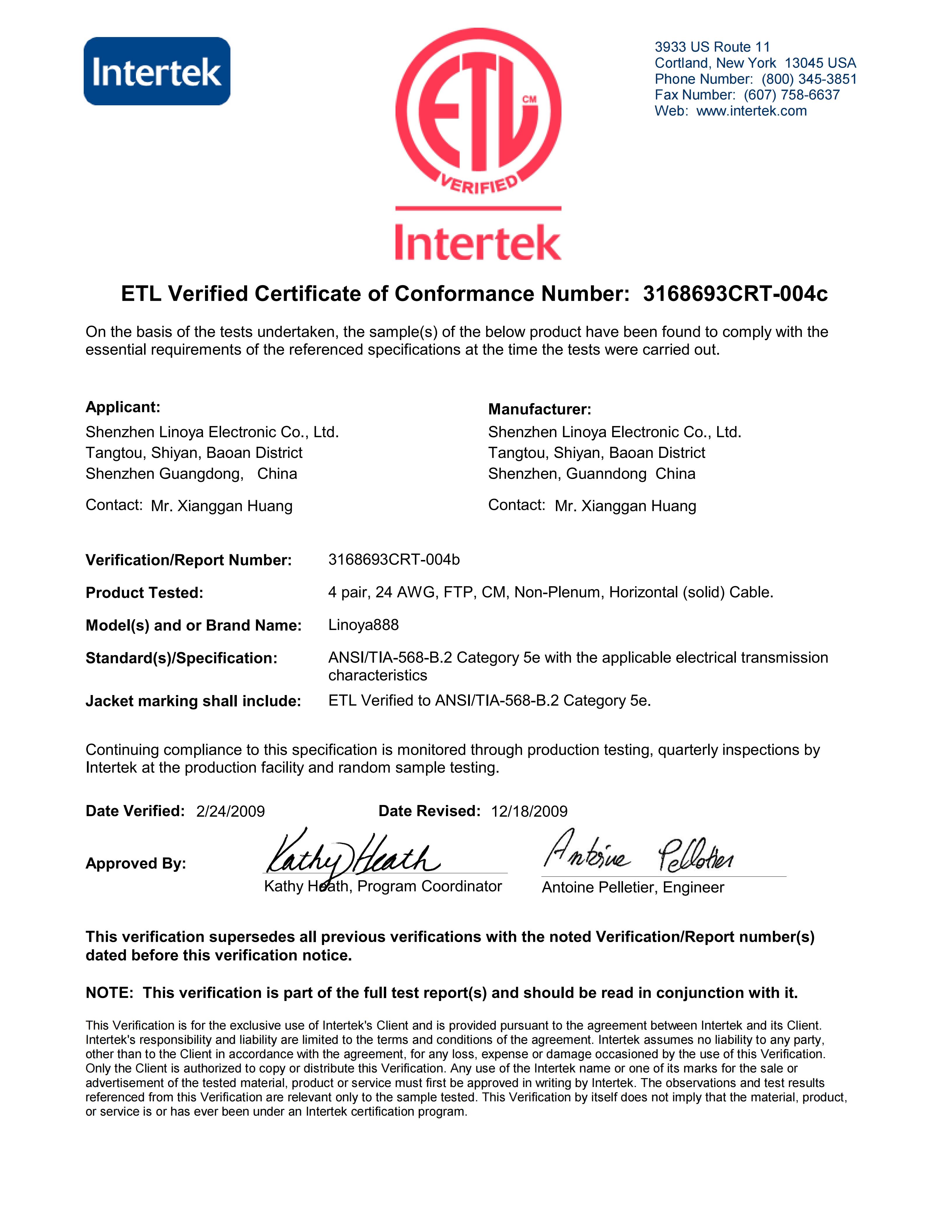
Certificate scope is part of acceptance: an ETL verified certificate names the tested construction, AWG, flame rating and standard.
3. Choosing Between Cat5e, Cat6 and Cat6a for the Deployment
The selection rule is driven by required speed, distance, power load and service life — not by category number alone.
- Cat5e suits projects that need stable 1 Gbps: general office LAN, IP surveillance with 30 W PoE, small commercial wiring. Procurement cost is lowest and installation tolerances are the most forgiving. It is not the right choice for 10 Gbps or high-power PoE++ devices.
- Cat6 fits cost-controlled projects needing 10 Gbps within 55 metres, or gigabit networks with upgrade headroom. It offers 250 MHz bandwidth and improved crosstalk performance over Cat5e, but 10G performance beyond 55 metres is not guaranteed. F/UTP and SF/UTP versions add foil or screen-plus-foil shielding for moderate to strong EMI.
- Cat6a is the choice for full-channel 10 Gbps at 100 metres, dense cable bundles, PoE++ up to 90 W and permanent building cabling intended to last through future upgrades. It passes stricter alien-crosstalk requirements; the trade-offs are larger cable diameter and higher overall project cost. U/UTP, SF/UTP and F/FTP versions are available for different interference levels.
- Cat7, Cat7a and Cat8 full-shielded constructions serve short-reach high-speed links: 40 Gbps at 50 m, 100 Gbps at 15 m and 40 Gbps at 30 m respectively, typically in data-centre and high-EMI backbone positions.
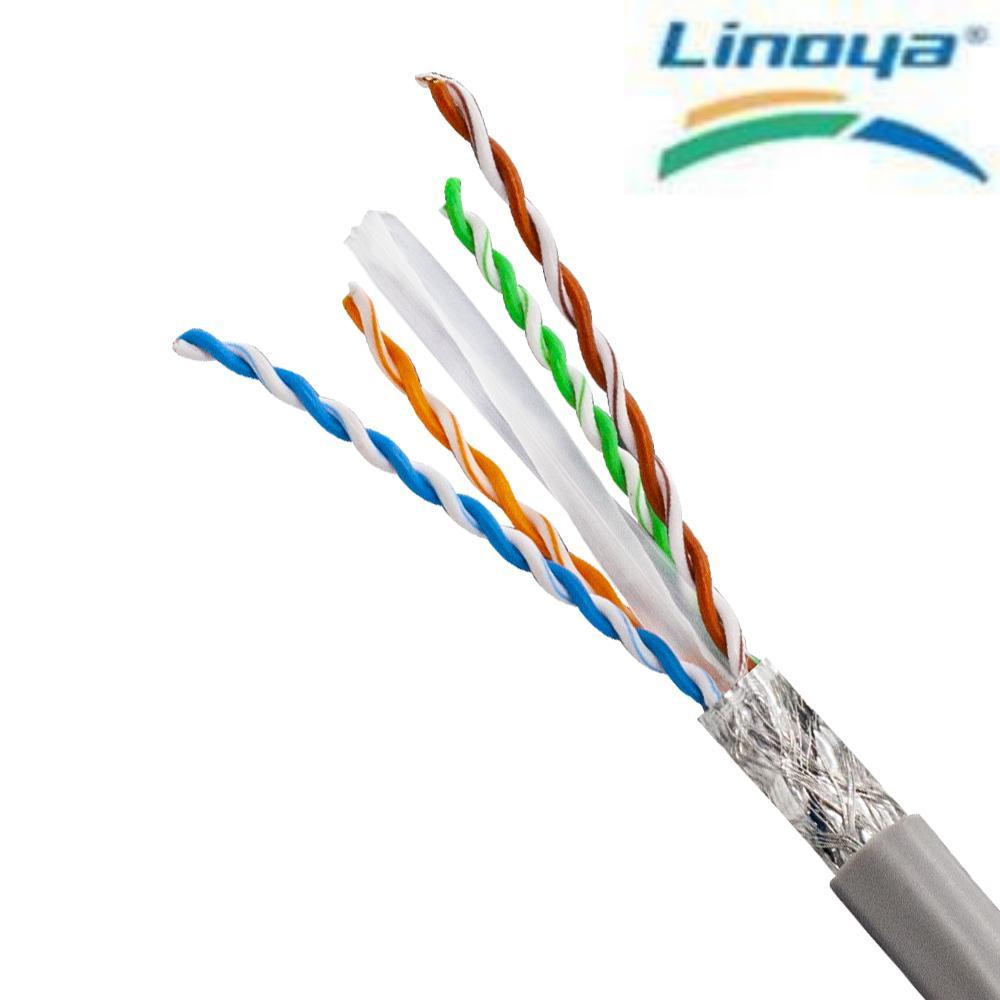
Screen-plus-foil Cat6 construction: the shielding layer that has to be named in the purchase order, not assumed from the word “Cat6”.
4. After-Sales Support Mapped to Application Needs
After-sales only means something when it is attached to a scenario.
- Enterprise data centres: the risk is a link that fails acceptance at 100 m under CMP-rated, high-density bundling. Support means documented 10 Gbps at 100 m performance, certificate copies ready for the project audit, and free replacement if a defective product is confirmed.
- High-EMI commercial buildings: the risk is intermittent packet loss caused by interference and incorrect shield grounding. Support means technical guidance on shielded construction selection and grounding practice, available 24/7 online.
- Office 10G construction: the risk is a cost-optimised Cat6 run exceeding 55 m. Support means distance-checking the design before the order is released, and switching the long runs to Cat6a.
- Export and tender projects: the risk is a document gap at customs or at third-party audit. Support means complete original certification documents — UL, ETL and CPR — supplied with the shipment.
Linoya’s standard after-sales package is 24/7 online technical support, a 1-year product warranty, free replacement for defective products and online after-sales consultation.
Step-by-Step: Setting Up a Rolling Supply Agreement
- Define the deployment, not the product. Record required rate, maximum run length, PoE load, bundle density and fire class for each area of the project. This produces a category list instead of a single category guess.
- Write acceptance criteria into the RFQ. Category plus shielding, AWG, conductor material, jacket material, flame rating, standard, certificate numbers, packaging length and inspection method.
- Verify certificate scope against the exact construction. Check that the UL file is active and covers the ordered flame rating, that the ETL certificate names a comparable model and standard, and that the CPR certificate class matches the installation area.
- Request samples and test them the way the site will. Continuity and mis-wiring via cable tester, link status on a live port, throughput under load, and PoE stability where relevant.
- Confirm commercial terms. MOQ of 100 cartons at 305 m per carton, 30-day lead time, and OEM scope covering cable length, logo printing and packaging.
- Agree the inspection protocol. 100% pre-shipment test, random sampling inspection, third-party inspection on request, and retention samples per batch.
- Define the after-sales service level. 24/7 online technical support, 1-year warranty and free replacement for confirmed defective products, with the contact channel named in the contract.
- Review after the first two shipments. Compare incoming inspection results with the retained samples and adjust the criteria list before the annual volume is released.
Use Cases: Where These Agreements Are Tested
Enterprise data centre — 10G server-to-switch links
A Cat6A U/UTP 23AWG construction delivers 10 Gbps at 100 m with CMP flame rating and UL/ETL/CPR certification coverage. In a Linoya project record for a data centre operator and enterprise IT department, a 2,000-carton order (305 m per carton) was delivered for server rack interconnection and enterprise 10G core network construction, with the documentation package used for data-centre acceptance.
High-EMI industrial and commercial environment — factory automation backbone
Where electromagnetic interference is heavy, full-shielded Cat6A F/FTP or Cat6A SF/UTP is the appropriate construction: 23AWG solid copper, overall plus pair foil shielding, 10 Gbps at 100 m, CMP rating. A Linoya record for an industrial automation integrator covers a 5,000-carton Cat6A F/FTP order for a heavy industrial automation network and production-line wiring.
Commercial building and office 10G construction — moderate EMI
For building vertical and horizontal cabling with moderate interference, Cat6 F/UTP provides foil shielding, CMR flame rating, UL/ETL certification and 10 Gbps at 55 m. A Linoya record for an engineering contractor covers a 3,000-carton Cat6 F/UTP order for commercial building vertical cabling and hotel room network wiring.
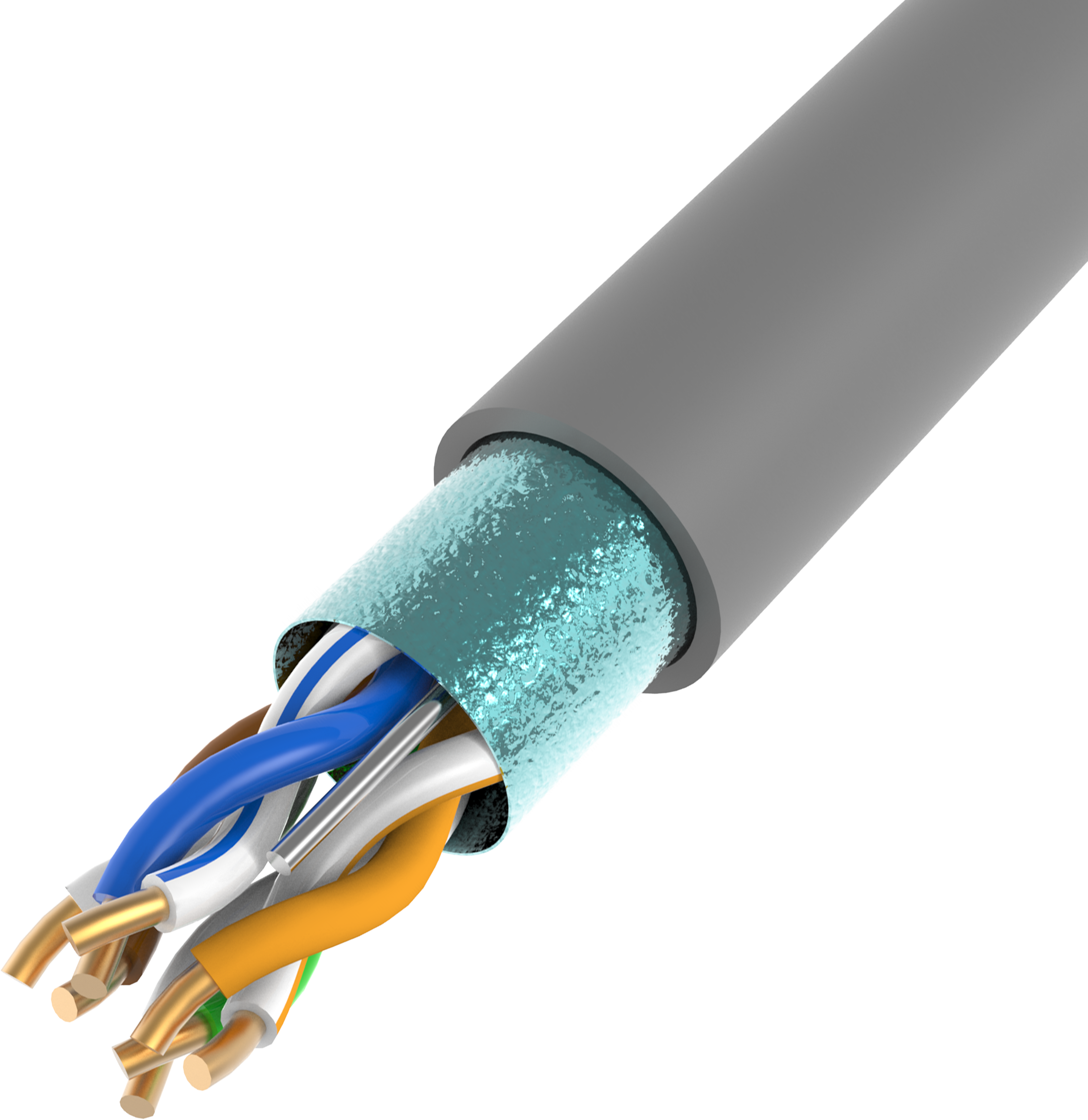
Cat5e F/UTP: the lowest-cost shielded entry point for 1 Gbps office and surveillance networks, still bound by the same acceptance criteria.
Comparison Table: Cat5e to Cat6a Constructions Buyers Order Most
| Attribute | Cat5e U/UTP | Cat6 U/UTP | Cat6 F/UTP | Cat6A U/UTP | Cat6A F/FTP |
|---|---|---|---|---|---|
| Conductor | 24AWG solid bare copper | 24AWG / 23AWG solid bare copper | 24AWG / 23AWG solid bare copper | 23AWG solid bare copper | 23AWG solid bare copper |
| Rate and distance | 1 Gbps | 10 Gbps at 55 m | 10 Gbps at 55 m | 10 Gbps at 100 m | 10 Gbps at 100 m |
| Shielding | None | None | Overall foil | None | Overall foil plus pair foil |
| Flame rating | CM / CMG | CMR | CMR | CMP | CMP |
| Certification coverage | UL / ETL | UL / ETL | UL / ETL | UL / ETL / CPR | UL / ETL / CPR |
| Jacket options | PVC / LSZH | PVC / LSZH | PVC / LSZH | PVC / LSZH | PVC / LSZH |
| Typical deployment | Office LAN, IP surveillance, 30 W PoE | Cost-controlled 10G short runs, office upgrade | Building cabling with moderate EMI | 10G backbone, data centre, PoE++ | Heavy-EMI industrial, dense data centre |
Read the table as a contract checklist rather than a ranking: the acceptance criteria, certificate scope and test method must match whichever row the project selects.
FAQ: Long-Term Ethernet Cable Supply
Which certificates should a bulk Ethernet cable supplier hold for North America and the EU?
For North America, a UL Certificate of Compliance such as Linoya’s E320763, covering CM, CMG, CMR and CMP types to UL 444 and CSA C22.2 No. 214-08, plus ETL verified certificates that name the exact model and standard — for example the Cat5e UTP CM certificate to ANSI/TIA-568.2-D and the Cat6A U/FTP certificate to ISO/IEC 11801-1. For the EU, a CPR reaction-to-fire classification issued by a Notified Body, such as the TÜV Rheinland Certificate of Constancy of Performance 1008-CPR-MC 69267303 0001 for B2ca-s1a,d0,a1, or EZÚ reports for Eca and Dca classifications. A laboratory test report alone does not replace the formal CPR-CE document.
What MOQ, monthly capacity and customization can a Cat5e UTP manufacturer commit to for bulk orders?
Linoya quotes a MOQ of 100 cartons at 305 m per carton and a monthly capacity of 200,000 cartons. OEM and customization cover cable length, logo printing and packaging. Quality control is 100% pre-shipment test, random sampling inspection, full electrical performance test and third-party inspection such as SGS or UL on request.
What drives the unit price of a bulk Ethernet cable order?
Unit price moves with category and conductor gauge (24AWG versus 23AWG versus 22AWG in the Cat7A and Cat8 ranges), shielding construction, jacket material (PVC versus LSZH), flame rating and the certification testing behind it, and any customization such as non-standard lengths, logo printing or custom packaging. Order volume relative to the 100-carton MOQ and the amount of customization are the two commercial levers the buyer controls.
Can we test samples before placing a bulk order, and what should the test cover?
Yes. Cover continuity and mis-wiring with a cable tester, link status on a live port, real throughput under load, and PoE stability where relevant. Linoya cables are additionally 100% factory tested for electrical performance before delivery, but a factory-tested cable still requires an on-site re-check after installation because termination quality and EMI conditions are created on site.
What lead time and after-sales coverage come with a rolling supply agreement?
Linoya quotes a 30-day lead time and supports buyers with 24/7 online technical support, a 1-year product warranty, free replacement for defective products and online after-sales consultation. Request a sample or a quotation against your acceptance criteria list and the response can be tied to your own specification rather than to a generic catalogue page.
Conclusion: Write the Criteria, Then Place the Order
A long-term Ethernet cable partnership is not secured by a low unit price or a wide product range. It is secured by three documents: an acceptance criteria list that names construction, AWG, flame rating and certificate scope; a test method that both parties accept at factory and on site; and an after-sales clause that states response channels, warranty length and replacement terms.
Once those exist, category selection becomes a straightforward engineering decision — Cat5e for 1 Gbps work, Cat6 for cost-controlled 10G inside 55 m, Cat6a for full 100 m 10G and PoE++ loads, and shielded or higher categories where interference and short-reach high speed demand it. The supplier’s job is then to keep delivering against a specification that was never left ambiguous.
A supplier able to support all three agreements with documented certification, batch-level testing and defined service terms is the one worth a rolling contract. Linoya Electronic Technology Co., Ltd. has produced cable and wire since 1997 from three industrial parks in Shenzhen and Dongguan plus a Vietnam production base, with an annual output of 4,000,000 kilometres, a 60,000 m² factory area, 3000+ employees, a 300+ engineer R&D team, and 30% of output exported to markets including the EU and the Middle East.
Next Step: Sample, Quotation or Certificate Package
Send your acceptance criteria list — category, construction, AWG, flame rating, target distance and destination market — and Linoya will respond with the matching construction, the applicable UL/ETL/CPR certificate numbers, and a quotation against your volume.
Email: inquiry@linoya.com | Tel: +86-15602610696 | WhatsApp: +86-13038893260
Website: www.linoya.com
Address: No.2, The Fourth West Industrial Road, High-Tech Industrial Development Zone, Songshan Lake, Dongguan City, Guangdong Province, China
Download the full product and capability catalogue: LINOYA ELECTRONIC TECHNOLOGY CO., LTD. PDF Catalogue
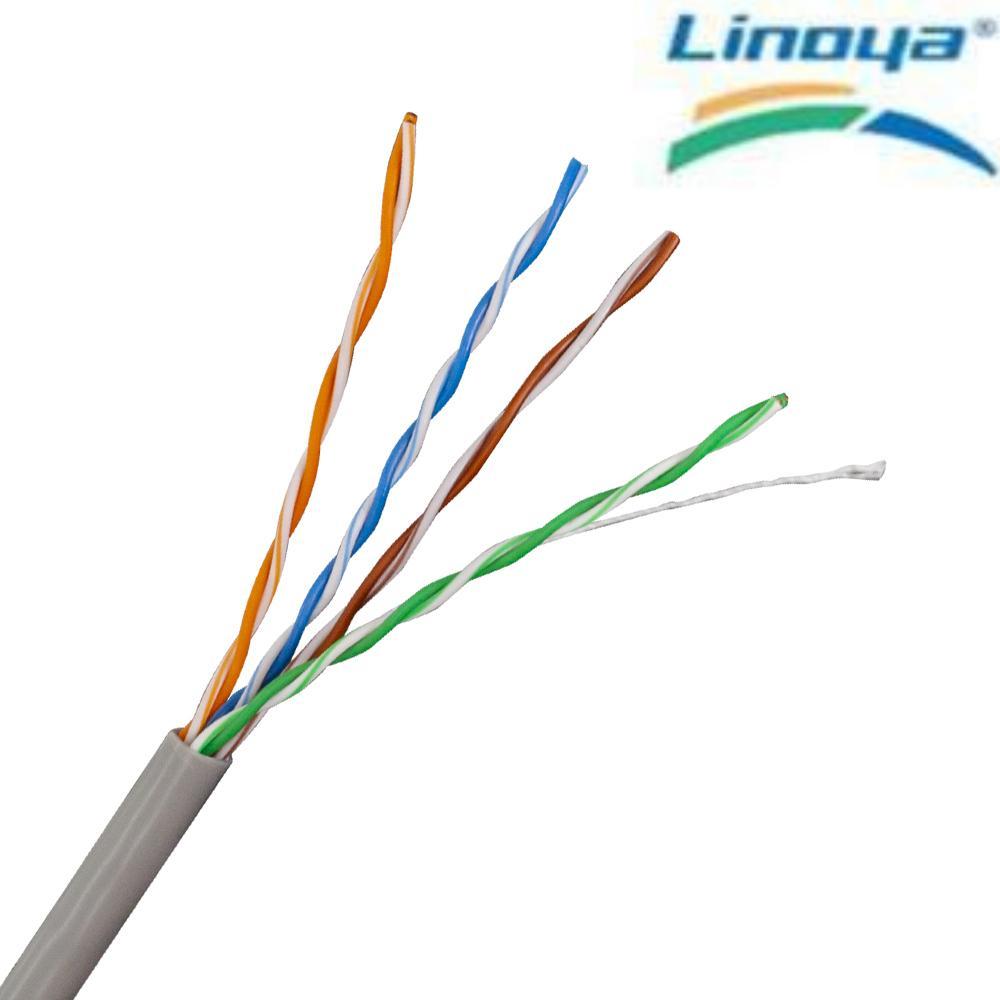
Sample first, then bulk: Cat5e U/UTP constructions are available for pre-order testing against your own acceptance criteria.
Have Questions or Need More Details?
Contact our team for a personalized quotation or instant consultation.
Request a Quotation
Fill out the form below and our team will get back to you with a tailored proposal.
WhatsApp Direct Chat
Prefer to chat in real-time? Message us on WhatsApp for instant assistance & quick answers.
- Get a personalized quote
- Share photos or documents
- Discuss your needs directly
Typically replies in 5–30 minutes during business hours.