
What Is an Ethernet Cable? A Practical Primer for Enterprise Network Buyers
An Ethernet cable is the twisted-pair copper cable that physically carries data between networked devices in a wired star topology. In an enterprise network it is the passive layer of the system: it generates no power of its own and makes no routing decisions, yet every switch port, workstation, wireless access point and IP camera depends on it for a stable electrical path. A cable that is underspecified for its run rarely fails outright. It negotiates a lower link speed, drops packets under load, or leaves a PoE device underpowered at the far end of the run.
This primer is written for buyers who are entering enterprise networking and need to translate a network requirement into a specific cable construction: category, shielding, conductor gauge, flame rating and compliance evidence. Product parameters and certification references below come from Linoya Electronic Technology Co., Ltd., a cable and wire manufacturer established in 1997 in Dongguan, China, whose portfolio covers Cat5e through Cat8 Ethernet cable and whose products are sold mainly into the EU and the Middle East (www.linoya.com).
Problem Definition: Why a "Simple Cable" Creates Specification Risk
"Ethernet cable" is one search term covering constructions that are not interchangeable: unshielded versus shielded designs, 24AWG to 22AWG conductors, CM to CMP flame ratings, PVC and LSZH jackets, indoor and outdoor builds, and both 305 m bulk reels and pre-terminated patch cords. Two cables that look identical in a product photo can behave very differently once they are installed in a riser, a ceiling void or a factory floor.
Professional troubleshooting records concentrate the same failure causes again and again:
- Physical damage — broken inner conductors, a crushed cable, a jacket cut during pulling, or bends beyond the cable's routing limit.
- Termination defects — wrong wiring sequence, untwisted pairs left too long at the plug, poor crimping, or damaged and oxidized RJ45 pins.
- Cable quality problems — CCA (copper-clad aluminium) conductors, off-spec category grades, or counterfeit product sold under a recognised category label.
- Environmental interference — heavy EMI, incorrect STP grounding, and indoor cable used where an outdoor construction was required.
- Connector mismatch — low-grade RJ45 connectors that cannot carry the high-frequency performance of Cat6 or Cat6a cable.
These faults surface as symptoms the buyer, not the installer, usually has to explain: no link light, frequent disconnection, slow network speed, random packet loss, unstable PoE power supply, or a link that reports 10/100 Mbps instead of the expected gigabit speed.
Because Ethernet cable carries signal passively, its limitations are invisible until the network is under load. That is why cable selection should be driven by four decisions taken before any price comparison: required speed, required distance, installation environment, and the compliance evidence the project's jurisdiction demands.
Industry Background: Where Ethernet Cable Sits in Today's Enterprise Networks
Ethernet cable is the largest single physical component in a structured cabling system, and the category is still expanding. Maximize Market Research values the global Ethernet cable market at USD 38.55 billion for 2025 and projects revenue of nearly USD 70.02 billion by 2032, an 8.9% CAGR for 2026–2032. Scope matters when reading such figures: a separate LAN-cable-focused estimate put the market at USD 7.09 billion in 2024, because narrower definitions exclude high-value industrial and data centre cabling. Buyers building a business case should check which product scope a market figure covers before using it.
Within the category, unshielded and foil-shielded Cat6 remains the volume workhorse. Commercial research covering 2025 places the Cat6 segment at a 32.5% share of the Ethernet cable market — a reminder that the decision most enterprise buyers actually face is not "which exotic category" but "which Cat6 or Cat6a construction, and how well is it verified."
Two regulatory threads also shape procurement in 2026:
- Standards: ANSI/TIA-568.2-E was released in October 2024, replacing ANSI/TIA-568.2-D, and introduced DC resistance unbalance (DCRU) specifications for Cat5e, Cat6 and Cat6A. Cable that was qualified only against the earlier revision may not have been characterised for this parameter.
- Fire performance in the EU: Under the Construction Products Regulation, the B2ca class represents high fire performance with thresholds of FS ≤ 1.5 m, THR ≤ 15 MJ and peak heat release rate ≤ 30 kW. Lower classes such as Eca and Dca are common for general horizontal cabling, while B2ca is required in many higher-risk building routes.
Customs classification follows the same logic of "does it have a connector or not": Ethernet patch cords with connectors fall under HS 8544.42, while bulk cable on a reel without connectors falls under HS 8544.49. The applied MFN duty rate for HS 8544.42.90 is 2.6% in the United States and 0% in the European Union, which matters when landed-cost models are compared for a multi-site roll-out.
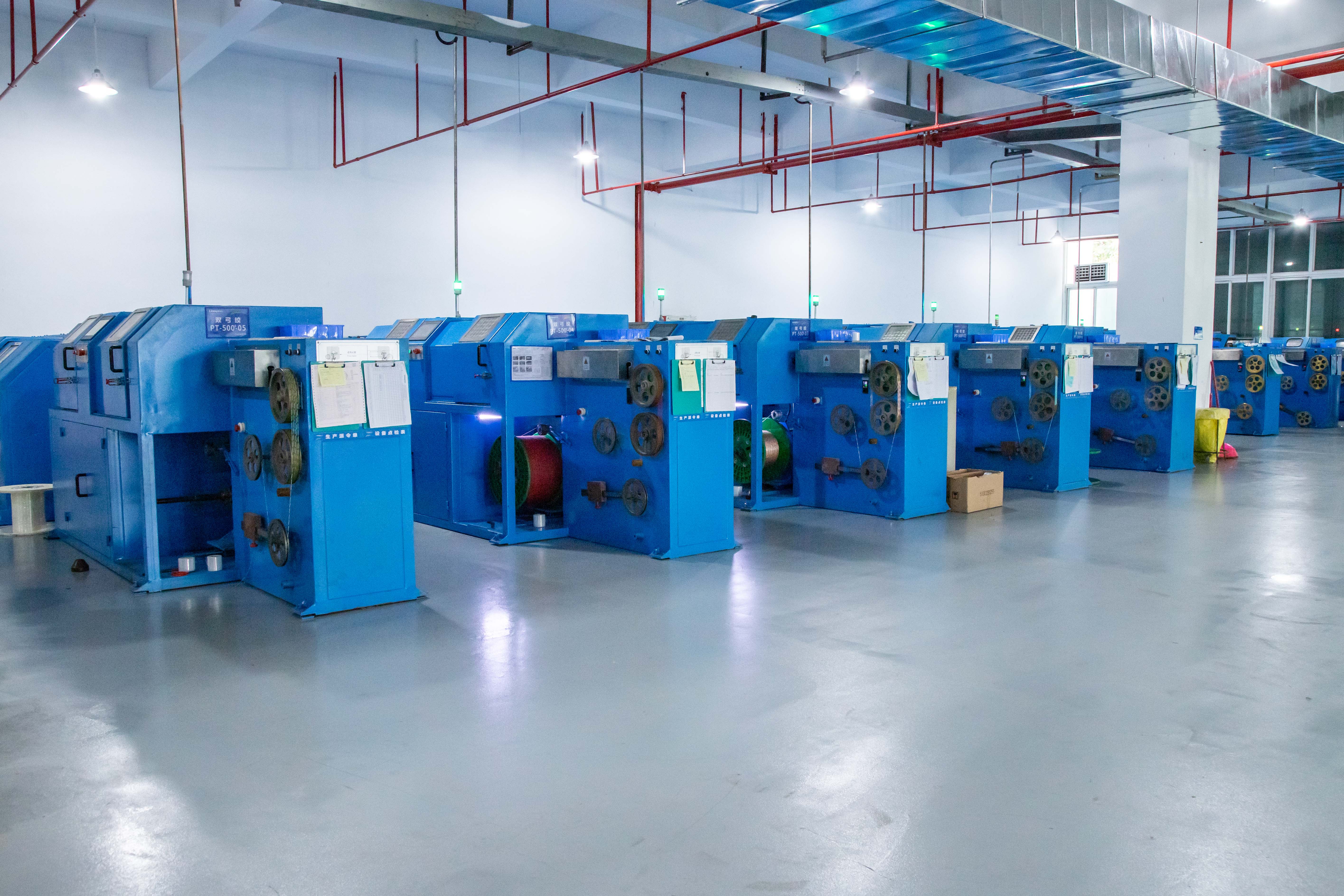
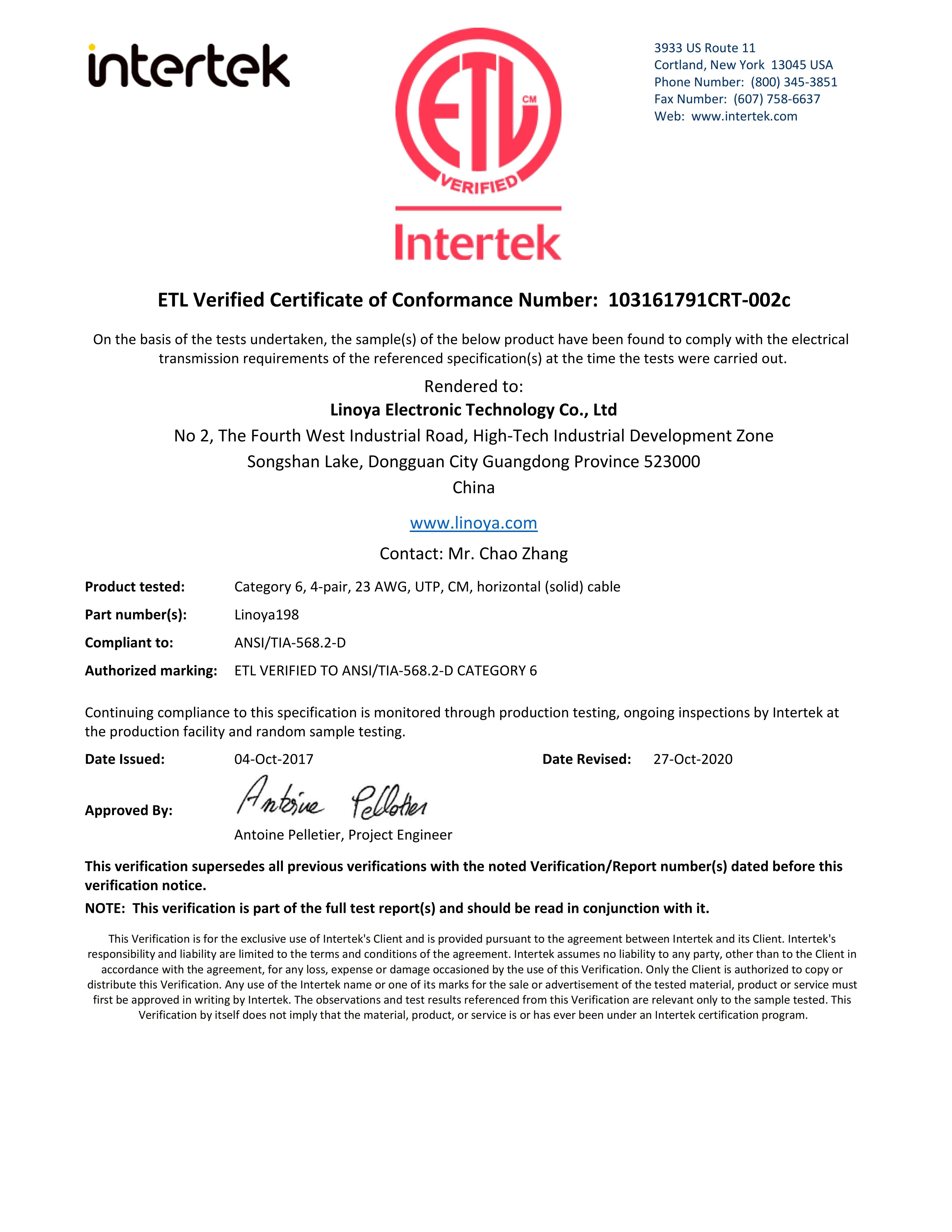
Linoya Electronic Technology Co., Ltd. sits inside this supply base as a vertically integrated manufacturer. The company operates three self-owned industrial parks in Shenzhen and Dongguan plus one production base in Vietnam and more than 100 production lines, with a 60,000 m² factory area, 3,000+ employees and 300+ engineers, and reports annual sales exceeding USD 420 million. Reported annual cable output is 4,000,000 kilometres, and roughly 30% of production is exported, with the EU and the Middle East as the main markets. The same industrial group produces the thermoplastic compounds used in cable jackets, including PVC, LSZH and XLPO grades.
Detailed Solution: What Enterprise Buyers Should Specify, Layer by Layer
Inside the cable: conductor, insulation and jacket
A four-pair Ethernet cable is built from the inside out. Four twisted pairs, each made of two insulated conductors, are assembled into a core and then covered by an outer jacket. Across the certified Linoya constructions in this article, the conductor is solid bare copper, the conductor insulation is LDPE, and the jacket is PVC or LSZH depending on the project's fire and halogen requirements.
The twisting is functional, not cosmetic. Crosstalk is signal leakage between adjacent twisted pairs inside the cable, and excessive crosstalk causes packet loss, slow speeds and unstable connections. Pair twist rates are therefore varied between pairs and tuned per category to keep that leakage within the limits of the applicable standard.
Shielding codes and what they actually mean
Shielding abbreviations describe two independent things: whether each pair has its own foil, and whether the whole cable has an overall screen or foil. Reading them correctly is the fastest way to compare two shielded cables that are priced differently.
- U/UTP — unshielded cable, unshielded pairs. Standard office and residential horizontal cabling, IP surveillance, SMB networks.
- F/UTP — one overall foil around all four pairs. Basic protection where minor electromagnetic interference exists.
- SF/UTP — an overall braided screen plus foil. Used where EMI is heavier, such as an industrial edge or a high-noise commercial environment.
- U/FTP — individual foil around each pair, no overall shield. Used in enterprise data centre and server room 10G links where low crosstalk is the priority.
- F/FTP — foil on each pair plus an overall foil. Full shielding for heavy-EMI industrial sites, data centres and public infrastructure.
Category, conductor gauge and rated performance
Category defines the electrical performance you are buying, and conductor gauge is one of the physical levers used to reach it. In the Linoya range, Cat5e uses 24AWG solid bare copper; Cat6 is offered in 24AWG and 23AWG; Cat6a and Cat7 use 23AWG; and Cat7A and Cat8 use 22AWG. Moving up a category usually means a larger overall diameter and a higher cost per metre, so the practical question is always whether the extra performance is actually needed for the run lengths in the project.
Flame rating is a separate axis from category. Cat5e constructions in this range carry CM/CMG, Cat6 carries CMR, and Cat6a and above carry CMP, with the shielding and jacket grade selectable on top of that.
Recommended construction sets for common enterprise roles
For buyers at the evaluation stage, the fastest path is to match the network role to a construction family and then confirm the compliance file for the destination market:
- General office horizontal cabling, home networking and IP surveillance on a controlled budget: Cat5e U/UTP, 24AWG solid copper, 1 Gbps, CM/CMG flame rating, UL/ETL certified.
- Offices and small commercial buildings with minor EMI: Cat5e F/UTP with an overall foil shield, 1 Gbps, CM/CMG.
- Industrial edge and high-noise office environments: Cat5e SF/UTP with screen plus foil, 1 Gbps, CM/CMG.
- Cost-controlled 10G up to 55 m: Cat6 U/UTP in 24AWG or 23AWG, CMR flame rating, PoE++ support.
- Commercial buildings and surveillance systems with EMI: Cat6 F/UTP or Cat6 SF/UTP, 10 Gbps at 55 m, CMR.
- Full-distance 10G over a 100 m horizontal run and PoE++ devices: Cat6a U/UTP, 23AWG solid copper, CMP, UL/ETL/CPR certified.
- Enterprise data centre 10G backbone with crosstalk control: Cat6a U/FTP with individual pair foil, 23AWG, CMP.
- Heavy-EMI industrial networking: Cat6a F/FTP with overall plus pair foil, 10 Gbps at 100 m, CMP.
- High-speed server interconnection: Cat7 F/FTP, 23AWG, 40 Gbps at 50 m.
- Premium data centre and ultra-high-speed links: Cat7A F/FTP, 22AWG, 100 Gbps at 15 m.
- Data centre cabinet-to-cabinet short-reach links: Cat8 F/FTP, 22AWG, 40 Gbps at 30 m, LSZH jacket optional.
Step-by-Step Breakdown: How to Specify an Ethernet Cable in Six Steps
- Write down the speed and the distance. A horizontal run to a desk is typically inside the range where Cat5e delivers 1 Gbps and Cat6 delivers 10 Gbps up to 55 m; a 10 Gbps run that must hold across a full 100 m channel points to Cat6a. Above that, define whether the link is a short in-rack connection, which is where Cat7, Cat7A and Cat8 constructions are used.
- Map the environment, not just the room. Note whether the route passes heavy EMI sources, whether the space above the ceiling is a plenum, whether the cable sits in a riser, and whether any part of the run is outdoor. Linoya's portfolio includes outdoor waterproof cables and connectors for routes that leave the building envelope, alongside indoor in-wall constructions for permanent horizontal cabling.
- Choose the category and the shielding code together. Category sets speed and frequency; the shielding code sets immunity. Selecting a higher category while ignoring EMI leads to expensive cable that still suffers interference, and selecting shielding where none is needed adds cost and grounding work.
- Decide solid versus stranded, gauge and jacket. Solid bare copper conductors are the correct choice for permanent links terminated once on a patch panel; cable supplied as 305 m bulk reels is intended for that fixed infrastructure. Jacket material is driven by fire and halogen policy: PVC where it is permitted, LSZH where low smoke and zero halogen performance is required.
- Collect the compliance file for the destination market. Ask for the certificate number, the authority, the product scope and the standard — not simply a logo. A certificate that lists a different pair count, AWG or flame rating from the cable you are buying is not evidence for your order.
- Validate after installation, not only before shipment. Plug both ends into a cable tester and read the LED sequence for open circuit, short circuit or mis-wiring; connect the run between a PC and a switch and check the RJ45 link light; then run a real throughput test. Terminate to the T568B wiring sequence and keep pair twists tight to the connector. Factory-tested cable still needs an on-site re-check after construction, because most field failures originate at the termination rather than in the reel.
Use Cases: How These Constructions Behave in Real Deployments
Commercial office and SMB 10G upgrades. A commercial building contractor and an SMB IT department built a 10G office network on Cat6 U/UTP, supplied as 4,000 cartons of 305 m cable. The construction offers dual 24AWG/23AWG options, CMR flame rating and PoE++ support. Reported project outcome: 99.99% network stability, stable 10G transmission and a passed 10G network performance test.
Commercial buildings with moderate EMI. An engineering contractor and a commercial property manager used Cat6 F/UTP for vertical cabling and office networks in a moderate-EMI building. The foil shield reduced crosstalk, and the project reported 99.98% network stability with consistent high-speed performance, on a CMR-rated, UL/ETL certified construction.
Industrial edge and heavy-EMI factory floors. An industrial automation integrator ran Cat6a F/FTP on a factory production line network in an extreme EMI environment. The full shielding structure delivered 99.997% network stability with stable 10G transmission, and the same shielded construction family has been in continuous deployment for over 25 years in industrial applications.
Enterprise data centre and 10G backbone. A data centre operator and an enterprise IT department used Cat6a U/FTP with individual pair shielding for server room wiring and a 10G backbone, reporting 99.999% network stability and eliminated crosstalk. For short-reach cabinet-to-cabinet interconnection, a separate deployment used Cat8 F/FTP (22AWG, 40 Gbps at 30 m) across 5,000 cartons, reporting 99.998% network stability with full shielding for signal integrity.

Comparison Table: Ethernet Cable Constructions Side by Side
The table below lists the Linoya Ethernet cable constructions covered in this primer, using the manufacturer's published parameters. All entries use solid bare copper conductors, LDPE insulation and PVC or LSZH jacket, and all are marked UL/ETL certified at Cat5e and Cat6 level, with UL/ETL/CPR certification at Cat6a and above.
| Model | Conductor | Shield structure | Rated performance | Flame rating | Typical enterprise role |
|---|---|---|---|---|---|
| CAT5E U/UTP | 24AWG solid copper | Unshielded | 1 Gbps | CM/CMG | Office horizontal cabling, IP surveillance, SMB networks |
| CAT5E F/UTP | 24AWG solid copper | Overall foil | 1 Gbps | CM/CMG | Offices and small commercial buildings with minor EMI |
| CAT5E SF/UTP | 24AWG solid copper | Screen + foil | 1 Gbps | CM/CMG | Industrial edge, high-noise office environments |
| CAT6 U/UTP | 24AWG / 23AWG solid copper | Unshielded | 10 Gbps at 55 m | CMR | Commercial office 10G, IP surveillance, SMB |
| CAT6 F/UTP | 24AWG / 23AWG solid copper | Overall foil | 10 Gbps at 55 m | CMR | Commercial buildings, surveillance systems with EMI |
| CAT6 SF/UTP | 24AWG / 23AWG solid copper | Screen + foil | 10 Gbps at 55 m | CMR | Industrial automation, enterprise network, security systems |
| CAT6A U/UTP | 23AWG solid copper | Unshielded | 10 Gbps at 100 m | CMP | Data centre, commercial office, 10G enterprise networking |
| CAT6A SF/UTP | 23AWG solid copper | Screen + foil | 10 Gbps at 100 m | CMP | Data centre, enterprise network, high-EMI commercial sites |
| CAT6A U/FTP | 23AWG solid copper | Individual pair foil | 10 Gbps at 100 m | CMP | Enterprise data centre, server room, 10G backbone |
| CAT6A F/FTP | 23AWG solid copper | Overall + pair foil | 10 Gbps at 100 m | CMP | Heavy-EMI industrial, data centre, public infrastructure |
| CAT7 F/FTP | 23AWG solid copper | Overall + pair foil | 40 Gbps at 50 m | CMP | High-EMI industrial, data centre, high-performance networking |
| CAT7A F/FTP | 22AWG solid copper | Overall + pair foil | 100 Gbps at 15 m | CMP | Premium data centre, ultra-high-speed links |
| CAT8 F/FTP | 22AWG solid copper | Overall + pair foil | 40 Gbps at 30 m | CMP | Data centre cabinet-to-cabinet short-reach links |
FAQ
1. What certifications should an Ethernet cable carry for US and EU enterprise projects?
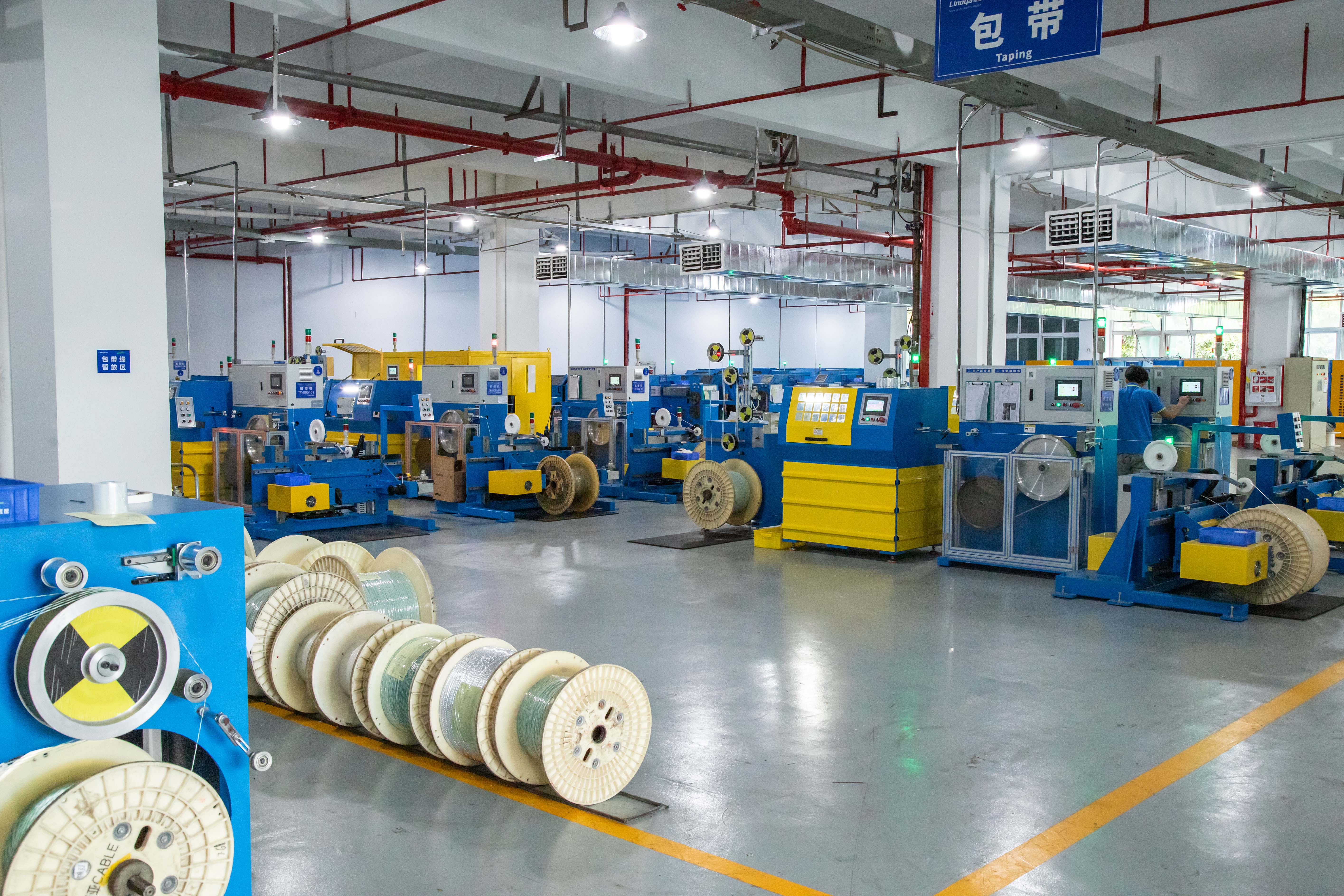
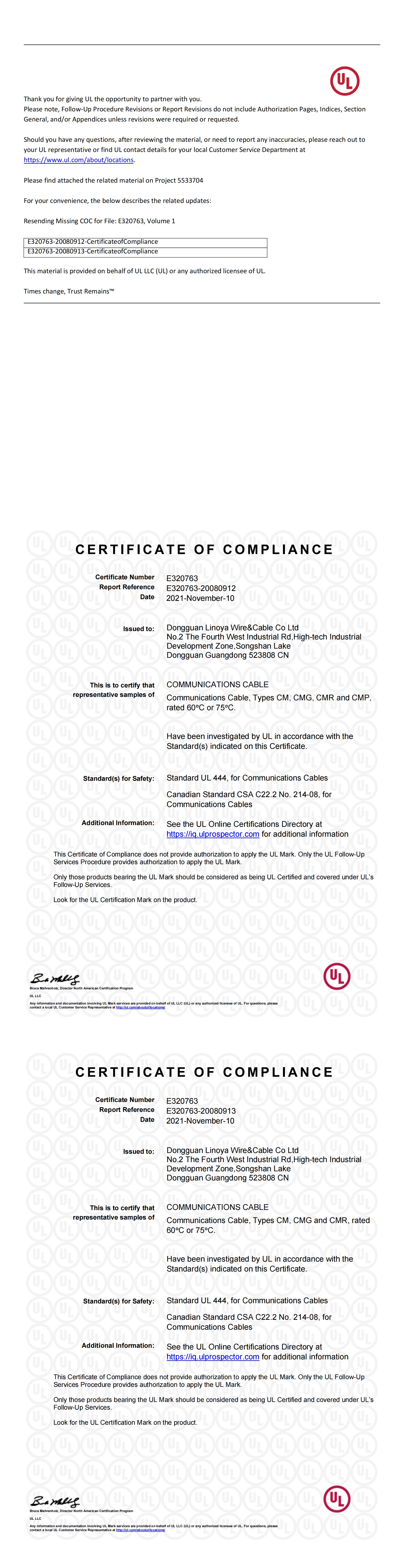
For North America, look for a UL Certificate of Compliance and ETL Verified certificates that name your exact construction. Linoya holds UL Certificate of Compliance E320763, issued by UL LLC for communications cable types CM, CMG, CMR and CMP rated 60°C or 75°C to UL 444 and CSA C22.2 No. 214-08, and ETL Verified certificates including 103161791CRT-002a for Category 5e 4-pair 24AWG UTP CM horizontal solid cable, 103161791CRT-002c for Category 6 4-pair 23AWG UTP CM horizontal solid cable (part number Linoya198), 3168693CRT-004c for Category 5e 4-pair 24AWG FTP CM, and 102500029CRT-002 for Category 6A 4-pair 23AWG U/FTP to ISO/IEC 11801-1. For the EU, construction products regulation evidence matters: the company holds Eca classification reports under EN 13501-6 for Cat5e and Cat6 constructions, Dca-s1,d1,a2 and Dca-s1a,d0,a2 classifications for LSZH LAN cable, and CPR Certificate of Constancy of Performance 1008-CPR-MC 69267303 0001 issued by TÜV Rheinland InterCert (Notified Body 1008) for B2ca-s1a,d0,a1 covering CAT6/6A/7/7A/8 S/FTP cables to EN 50575:2014+A1:2016.
2. Can a supplier actually support project-scale Ethernet cable volumes?
Volume capability can be checked against published figures rather than promises. Linoya states a monthly production capacity of 200,000 cartons at 305 metres per carton, a minimum order quantity of 100 cartons, and a 30-day lead time. The company operates three industrial parks in Shenzhen and Dongguan, one production base in Vietnam and more than 100 production lines, with reported annual cable output of 4,000,000 kilometres and 300+ engineers. Quality control includes 100% pre-shipment testing, random sampling inspection and full electrical performance testing, with third-party inspection such as SGS or UL available on request. Export markets cover the EU, US, Middle East, Southeast Asia, Australia, South Korea and Japan.
3. How do I choose between Cat5e, Cat6 and Cat6a without overspending?
Choose the lowest category that satisfies the speed, distance and power requirement of the project. Cat5e is appropriate for stable 1 Gbps links, general office LANs and PoE surveillance cameras at 30W PoE+, with low procurement cost and forgiving installation requirements; it is not suited to 10 Gbps or high-power PoE++ devices. Cat6 fits cost-controlled projects that need short-range 10 Gbps within 55 metres and want upgrade headroom, with higher bandwidth and improved crosstalk performance than Cat5e, but 10G cannot be guaranteed beyond 55 metres. Cat6a is the choice for stable 10 Gbps across a full 100 m channel, dense cable bundling, PoE++ devices up to 90W and long-term permanent building cabling; its trade-offs are a larger cable diameter and a higher overall project cost. Adding shielding, LSZH jacket or a higher CPR class increases cost further, so specify those only where the environment or the regulation requires them.
4. How can a buyer validate an Ethernet cable before committing to a bulk order?
Validation has two stages. Before the order, request samples of the exact construction — category, shield code, gauge and jacket — and check the certificate scope against the cable you are buying. After delivery and installation, test the finished link: plug both ends into a cable tester and read the LED sequence for open circuit, short circuit or mis-wiring; connect the cable between a PC and a router and confirm the RJ45 link light; then run a network speed test to verify actual throughput. Replace the cable if mis-wiring or low throughput appears. Note that Linoya cables are factory-tested, but the on-site check after construction is still required, because termination faults happen in the field. Samples and specification sheets can be requested directly from Linoya before a project is committed (www.linoya.com).
5. What lead time and after-sales support should buyers expect?
Linoya quotes a 30-day lead time against a minimum order quantity of 100 cartons of 305 m cable, with OEM and customisation options covering cable length, logo printing and packaging for brand owners and distributors. After delivery, the manufacturer provides 24/7 online technical support, a 1-year product warranty, free replacement for defective products and online after-sales consultation. For a project quotation, sample request or the full product catalogue, contact the team at inquiry@linoya.com or +86-15602610696.
Conclusion
An Ethernet cable is a passive twisted-pair copper assembly whose job is simple to describe and easy to get wrong. The cable itself does not create a network; it decides whether the network you paid for can actually reach the workstation at the other end. For enterprise buyers, that means treating the specification as four decisions — speed, distance, environment, and verifiable compliance — and only then comparing cost per metre.
Once those four decisions are fixed, the construction usually selects itself: Cat5e U/UTP for standard office and surveillance links, Cat6 U/UTP or F/UTP for cost-controlled 10G and commercial buildings, Cat6a for full 100 m 10G and PoE++ where crosstalk control matters, and the fully shielded Cat7, Cat7A and Cat8 families for industrial EMI and data centre short-reach interconnection. The remaining work is administrative but decisive: match the certificate to the cable, and test the link after installation.
Linoya Electronic Technology Co., Ltd. manufactures this full range in Guangdong and Vietnam, with 22AWG to 24AWG solid bare copper constructions, PVC and LSZH jacket options, and UL, ETL and CPR certification files covering both the North American and European markets. Buyers who want to validate a construction on their own project can start with a sample reel rather than a container.
Next step: sample, quotation or catalogue
Send your project parameters — category, shielding, conductor gauge, jacket, flame rating, destination market and annual volume — and Linoya will confirm the matching construction, the certificate scope and the lead time for your order.
Contact: inquiry@linoya.com | Tel: +86-15602610696 | WhatsApp: +86-13038893260
Address: No.2, The Fourth West Industrial Road, High-Tech Industrial Development Zone, Songshan Lake, Dongguan City, Guangdong Province, China.
Download the full company and product brochure: LINOYA ELECTRONIC TECHNOLOGY CO., LTD. (PDF)
Have Questions or Need More Details?
Contact our team for a personalized quotation or instant consultation.
Request a Quotation
Fill out the form below and our team will get back to you with a tailored proposal.
WhatsApp Direct Chat
Prefer to chat in real-time? Message us on WhatsApp for instant assistance & quick answers.
- Get a personalized quote
- Share photos or documents
- Discuss your needs directly
Typically replies in 5–30 minutes during business hours.