
Outdoor Waterproof Ethernet Cable: Construction, Standards, and Manufacturer Selection
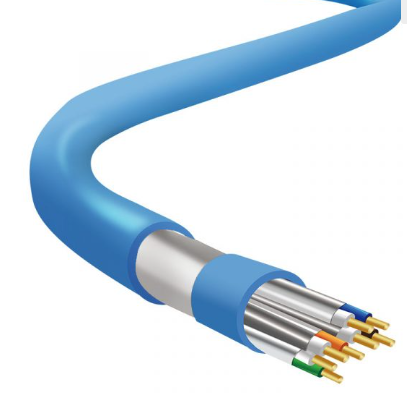
An outdoor waterproof Ethernet cable is a twisted-pair network cable built for permanent installation outside a building envelope. Three properties separate it from an indoor horizontal cable: a jacket compound that tolerates ultraviolet radiation, standing moisture and temperature cycling; solid bare copper conductors sized for the full channel length; and, in most outdoor deployments, a shielding system with a grounded drainage path that survives lightning-induced surges and the ground-potential difference between two structures. Category — Cat5e, Cat6, Cat6a, Cat7 or Cat8 — is the second question, not the first.
Most outdoor link failures are not caused by choosing the wrong category. They are caused by an indoor PVC-jacketed cable installed on a pole or a rooftop, by a shielded cable whose drain wire was never bonded to ground, or by a connector interface that lets water follow the cable into the RJ45 plug. This guide explains what actually determines outdoor performance, which standards and certifications matter when buying for the EU or the Middle East, and how to evaluate an outdoor waterproof Ethernet cable manufacturer before a purchase order is issued.
Linoya Electronic Technology Co., Ltd. is a cable and wire manufacturer established in 1997 and based in Dongguan, Guangdong Province, China. The company manufactures cable and wire, and its product range includes network cables and high-speed data transmission cables and components, outdoor waterproof cables and connectors, and outdoor smart connection and transmission solutions.
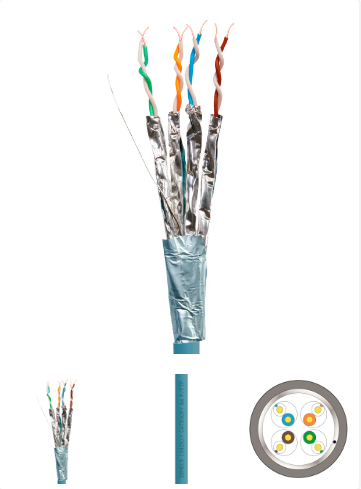
CAT6A F/FTP full shielded Ethernet cable — one of the fully shielded constructions used in the network cable range. Conductors: solid bare copper. Bandwidth: 10Gbps@100m.
Problem Definition: Why an Indoor Cable Fails in an Outdoor Run
The failure pattern is well documented in field troubleshooting. When an outdoor link degrades, the symptoms usually appear in this order:
- No network link light on the switch or camera port
- Frequent disconnection, or a link that renegotiates itself at random
- Slow throughput, random packet loss, or unstable PoE power supply
- A link that reports 10/100Mbps instead of the expected gigabit speed
The documented causes fall into five groups, and four of them are directly related to whether the cable was designed for outdoor service.
- Physical damage: broken inner conductors, crushed cable, scratched jacket, or routing bends beyond the minimum bend radius.
- Termination defects: wrong wiring sequence, untwisted pairs left too long, poor crimping, damaged or oxidized RJ45 pins.
- Cable quality issues: CCA (copper-clad aluminium) conductor, off-spec cable grade, or counterfeit product.
- Environmental interference: heavy EMI, incorrect STP grounding, and mixed indoor/outdoor cable usage within the same channel.
- Connector mismatch: low-grade RJ45 connectors that cannot support the high-frequency performance of Cat6 or Cat6a.
A note on diagnosis: cable testers, the port link indicator and a real-world throughput test will identify an open circuit, a short circuit or mis-wiring. They will not tell you that the jacket has already lost its UV stabilizer, or that the drain wire is floating. Those two conditions only become visible as an intermittent fault months after commissioning.
Industry Background: Why Outdoor Waterproof Ethernet Cable Is Now a Procurement Category
Outdoor data cabling used to be an exception item. It is now a standard line item in three growing categories: perimeter and street-level video surveillance, outdoor base stations and small-cell sites, and industrial equipment cabinets placed outside a plant wall. In all three, the same cable must carry data and power on the same run, which raises the electrical demands on the conductor and the thermal demands on the jacket.
Cable is also a passive component inside a larger bill of materials, which creates a structural procurement risk: because the cable is a small share of project cost, it is often the item that is optimized on unit price rather than on installed reliability. The corrective action is to specify by construction and certification first, then compare commercials.
On the regulatory side, three layers apply to an outdoor waterproof Ethernet cable sold into EU and Middle East projects:
- Transmission standards: TIA/EIA-568-C.2 for the channel performance class, alongside EN and GB standards for regional projects.
- Flame ratings: CM/CMG, CMR and CMP ratings, selected according to where the cable is installed and whether it re-enters a building.
- Certification and CPR: UL and ETL listing for electrical safety, and CPR performance classification for cables used in construction works in the European Union.
Manufacturing capacity matters as much as the specification when a project has a construction schedule attached to it. Linoya operates a 60,000 m² manufacturing facility with more than 3,000 staff and an R&D team of more than 300 engineers. Annual production capacity reaches 4,000,000 kilometres of cable and wire, which supports stable output for recurring and long-term cable supply programs. Export business accounts for 30% of total sales, and the company's principal overseas sales regions are the EU and the Middle East; its products are sold in dozens of countries and regions worldwide.
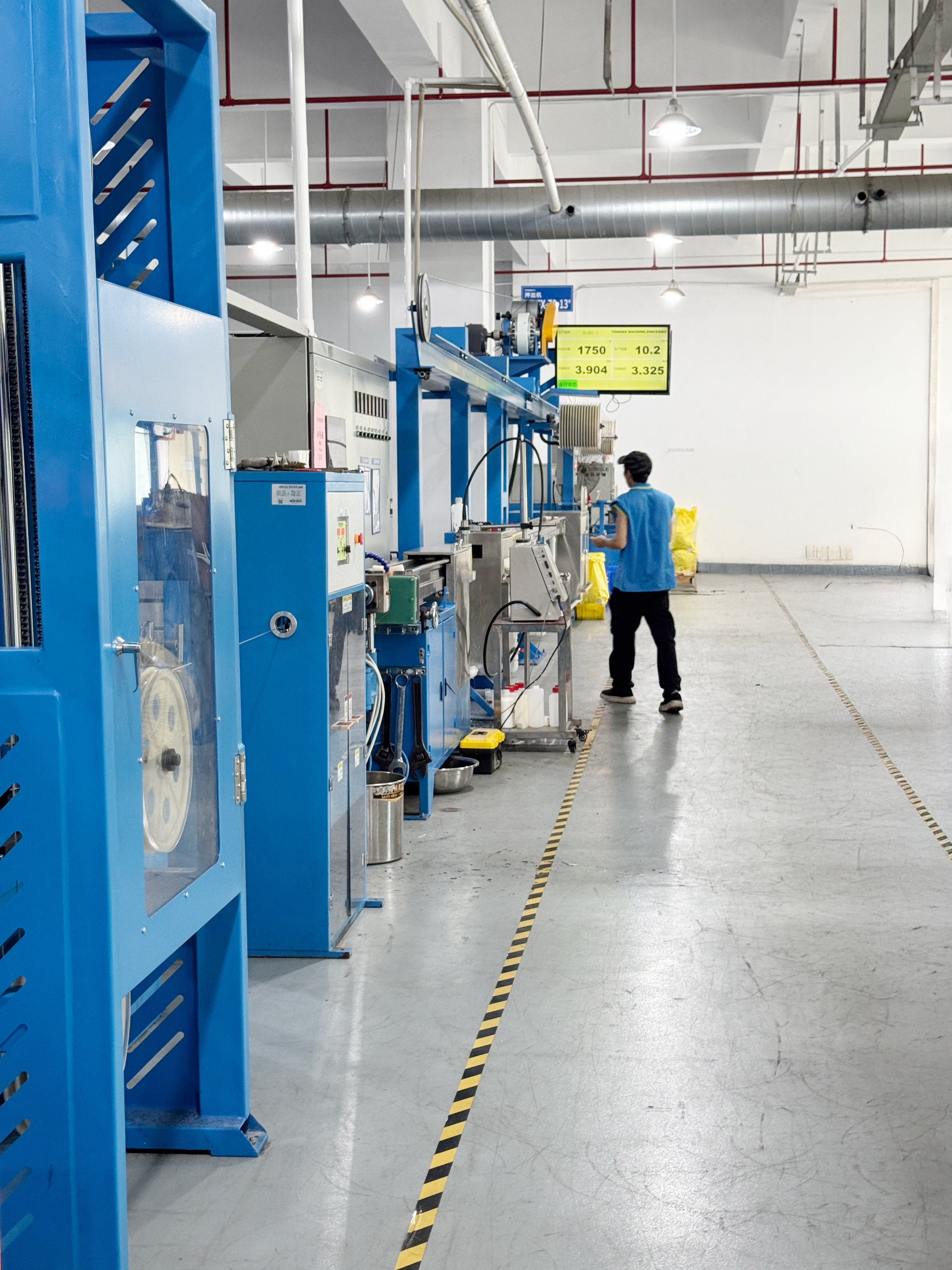
Jacket extrusion is where the outdoor performance of a cable is physically determined. The compound selected at this stage is the difference between a cable that survives ten summers and one that does not survive two.
Detailed Solution: Five Construction Decisions That Determine Outdoor Performance
1. Conductor: solid bare copper, not CCA
Every network cable series in the Linoya range uses solid bare copper conductors. This matters more outdoors than indoors. Outdoor runs are almost always permanent, fixed installations, where solid conductors terminate well in IDC blocks and patch panels; power is frequently delivered over the same cable, which makes conductor resistance a design constraint rather than a footnote; and outdoor channels are the hardest place to replace a cable after water ingress. Copper-clad aluminium is a documented cause of premature field failure and is one of the quality issues that appears in troubleshooting records.
Conductor gauge is specified per category: 24AWG for the Cat5e range, 24AWG and 23AWG options in the Cat6 range, 23AWG for Cat6a and Cat7, and 22AWG for the Cat7A and Cat8 ranges.
2. Insulation and jacket compound
Conductor insulation in this range is LDPE (low-density polyethylene). The outer jacket is the part that lives in the weather. Standard configurations are available with PVC or LSZH jackets, and the company works with a broader thermoplastic polymer portfolio that includes PVC, CTPE, TPE, TPU, PUR, XLPE, XLPO, low-smoke zero-halogen (LSZH) and FPE.
This is the point where buyers searching for a PE jacket outdoor waterproof Ethernet cable, or a UV resistant outdoor Ethernet cable, should slow down and be precise. Polyethylene-based and cross-linked compounds are selected precisely because general-purpose PVC performs poorly under sustained sunlight and standing water. But the phrase on the datasheet is not the deliverable — the specification on the purchase order is. Buyers should state the required jacket compound explicitly, confirm that the supplier's compound choice is intended for permanent outdoor exposure, and record that confirmation in writing before tooling is scheduled.
3. Shielding: five constructions, five different jobs
Shielding protects the signal in two different ways — by blocking external electromagnetic interference and by limiting signal leakage between pairs. The range covers U/UTP (unshielded), F/UTP (overall foil), SF/UTP (screen plus foil), U/FTP (individual pair foil) and F/FTP (overall plus pair foil).
For outdoor work, shielding has a second function that indoor specification sheets rarely mention: a metallic shield with a drain wire is the path that carries induced surge current away from the signal conductors, provided it is properly bonded. That is why an outdoor rack, mast or pole installation with an unshielded indoor cable has no defined path for a lightning-induced transient, and why incorrect STP grounding is listed among the documented causes of unstable outdoor links.
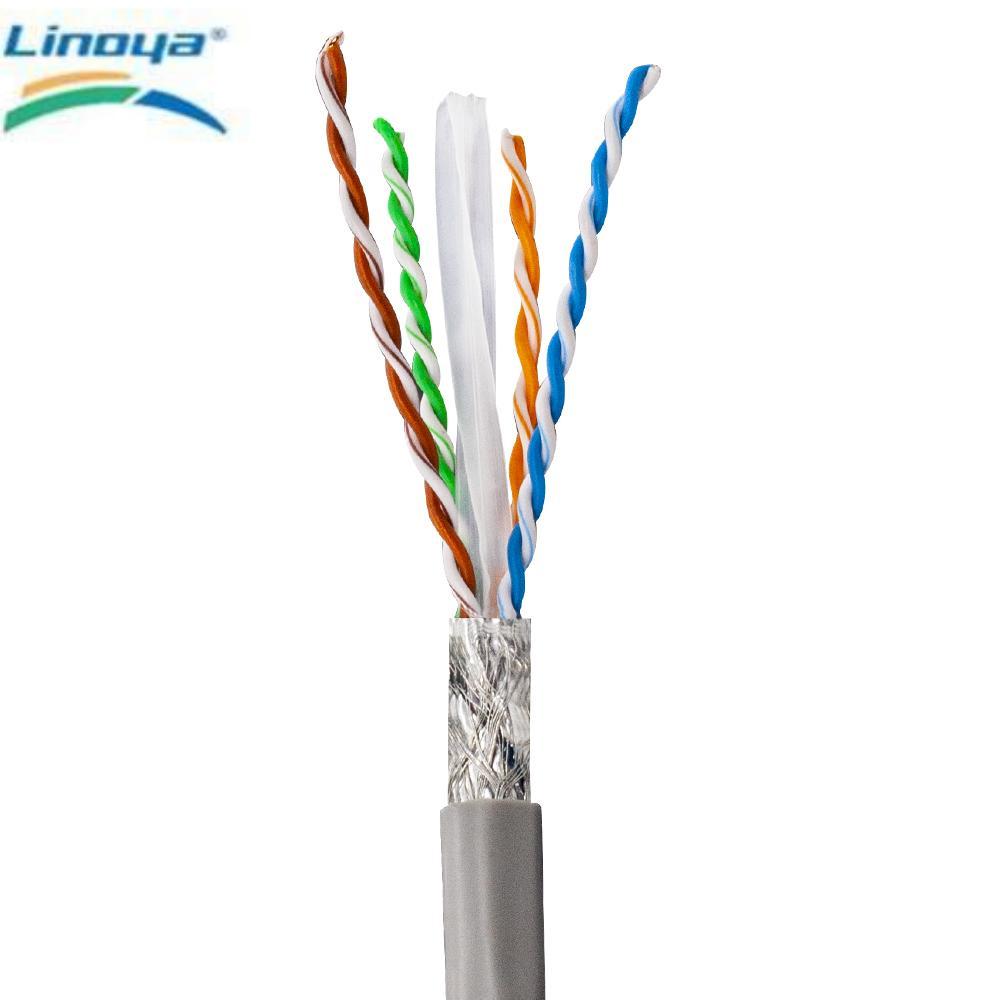
CAT6 SF/UTP screen-foil shielded construction with 24AWG/23AWG solid bare copper, 10Gbps@55m, CMR flame rating, UL/ETL certified.
4. Waterproofing at the connector interface
A waterproof jacket on its own does not make a channel waterproof. Water most commonly enters a link at the points where the cable is opened: the RJ45 plug itself, the equipment port, and the cabinet gland. This is why the supply scope matters. Linoya supplies outdoor waterproof cables and connectors and outdoor smart connection and transmission solutions, which allows the jacket, the connector housing and the entry into the equipment enclosure to be specified as one system instead of three separate purchases.
Practical requirements for this stage include pre-terminated assemblies where site crimping quality cannot be controlled, a drip loop below every outdoor connector, strain relief at the enclosure entry, and correct RJ45 connector grade — a low-grade connector will not support the high-frequency performance of a Cat6 or Cat6a cable even if the cable itself is correctly specified.
5. Grounding, bonding and surge protection
Two buildings on the same campus rarely share exactly the same ground potential. On a long outdoor run, that difference appears as a current on the shield and, in a lightning event, as a transient on the signal pairs. The construction answer is a continuous shield, a drain wire that is properly bonded at the designated point, and an external surge protective device at the building entry, installed per local electrical code. For lightning protection on outdoor Ethernet cable, the cable is part of the solution — it is never the entire solution.
Step-by-Step Breakdown: How to Specify and Verify the Cable
- Map the physical run. Record the actual route length, whether the cable is aerial, buried or clipped to a structure, the maximum and minimum ambient temperature, and every point where the jacket will be opened.
- Set the data rate and the channel length. This is the decision that eliminates most of the range. Cat5e carries 1Gbps. Cat6 carries 10Gbps at 55 metres. Cat6a carries 10Gbps at 100 metres. Cat7 carries 40Gbps at 50 metres, and Cat7A carries 100Gbps at 15 metres.
- Calculate the PoE load. If the outdoor device is powered over the cable, the power class drives the conductor gauge and the number of cables per conduit. Cat6 U/UTP in this range is documented for stable PoE++ support, and Cat7 F/FTP is documented for PoE++ performance.
- Choose the shield type from the interference environment. Unshielded for a clean run to a roadside cabinet; foil or screen-foil shielding where the cable passes close to power distribution; full overall plus pair shielding where the run is long, the EMI is heavy, or induced surge risk is real.
- Specify the conductor and jacket explicitly. State solid bare copper, state the AWG, state the jacket compound, and state that the compound is intended for permanent outdoor exposure.
- Specify the connector and the enclosure entry. Decide whether the project uses factory-terminated assemblies or site crimping, and confirm the connector grade matches the cable category.
- Request the compliance documents per SKU. Do not accept a company-level certificate pack. Ask for the specific certificate that covers the exact model ordered.
- Validate with a sample and re-test on site. A factory electrical performance test confirms the cable left the plant correctly. It does not confirm the installation. Finished cables from Linoya are factory-tested before delivery, and site continuity and throughput testing still needs to be carried out after construction.

Cat6 U/UTP unshielded construction, 24AWG/23AWG solid bare copper, 10Gbps@55m. Unshielded constructions remain the cost-optimised choice for indoor horizontal cabling and short, clean outdoor runs.
Use Cases: Where an Outdoor Waterproof Ethernet Cable Is the Right Answer
Outdoor surveillance and perimeter camera networks
Pole-mounted cameras combine the two hardest conditions: continuous PoE power delivery over a long cable, and a connector that sits in direct weather. The camera end of the link is where a waterproof connector system earns its cost back. For 1Gbps PoE cameras the Cat5e range is sufficient; for 10Gbps backhaul from a camera aggregation point, Cat6 or Cat6a is the appropriate starting point.
Outdoor base station and small-cell data runs
Radio sites concentrate three risks in a small footprint: high electromagnetic exposure, elevated surge risk on the mast, and elevated ground potential during a lightning event. Fully shielded constructions — Cat6a F/FTP, Cat7 F/FTP, Cat7A F/FTP and Cat8 F/FTP — are the documented options for high-EMI and ultra-high-speed link environments, with the 22AWG and 23AWG solid copper conductors suited to short-reach, high-rate links.
Industrial outdoor edge cabinets
Cabinets mounted outside a plant wall frequently sit next to variable-frequency drives, motor starters and welding equipment. This is a heavy-EMI environment where shielding is a functional requirement rather than an upgrade. Cat6a F/FTP and Cat7 F/FTP are documented for heavy-EMI industrial and public infrastructure deployment.
Adjacent industries that share the same construction requirements
Linoya products are used in new energy vehicles, photovoltaic energy storage, industrial automation, cloud computing, the Internet of Things, smart cities, smart homes and 3D printing. The material and process knowledge behind those product lines — compounding, extrusion, shielding and electrical testing — is the same knowledge base that produces an outdoor-rated network cable.
Category and Shield Comparison for Outdoor Projects
The table below lists the network cable constructions in the Linoya range, with the parameters documented for each model. It is intended as a starting filter, not as a substitute for the project specification.
| Model | Construction | Conductor | Documented bandwidth | Flame rating | Certification |
|---|---|---|---|---|---|
| CAT5E U/UTP | Unshielded | 24AWG solid bare copper | 1Gbps | CM/CMG | UL/ETL |
| CAT5E F/UTP | Overall foil shield | 24AWG solid bare copper | 1Gbps | CM/CMG | UL/ETL |
| CAT5E SF/UTP | Screen + foil overall shield | 24AWG solid bare copper | 1Gbps | CM/CMG | UL/ETL |
| CAT6 U/UTP | Unshielded | 24AWG/23AWG solid bare copper | 10Gbps@55m | CMR | UL/ETL |
| CAT6 F/UTP | Overall foil shield | 24AWG/23AWG solid bare copper | 10Gbps@55m | CMR | UL/ETL |
| CAT6 SF/UTP | Screen + foil overall shield | 24AWG/23AWG solid bare copper | 10Gbps@55m | CMR | UL/ETL |
| CAT6A U/UTP | Unshielded | 23AWG solid bare copper | 10Gbps@100m | CMP | UL/ETL/CPR |
| CAT6A SF/UTP | Screen + foil overall shield | 23AWG solid bare copper | 10Gbps@100m | CMP | UL/ETL/CPR |
| CAT6A U/FTP | Individual pair foil shield | 23AWG solid bare copper | 10Gbps@100m | CMP | UL/ETL/CPR |
| CAT6A F/FTP | Overall + pair full foil shield | 23AWG solid bare copper | 10Gbps@100m | CMP | UL/ETL/CPR |
| CAT7 F/FTP | Overall + pair full foil shield | 23AWG solid bare copper | 40Gbps@50m | CMP | UL/ETL/CPR |
| CAT7A F/FTP | Overall + pair full foil shield | 22AWG solid bare copper | 100Gbps@15m | CMP | UL/ETL/CPR |
| CAT8 F/FTP | Overall + pair full foil shield | 22AWG solid bare copper | 40Gbps@30m | CMP | UL/ETL/CPR |
All models comply with TIA/EIA-568-C.2 and with EN and GB standards. The CMP-rated Cat6a, Cat7, Cat7A and Cat8 models carry UL, ETL and CPR certification.
| Shield construction | Documented structure | Documented environment |
|---|---|---|
| U/UTP | No shield | Commercial office, home networking, IP surveillance, SMB |
| F/UTP | Overall foil shield | Commercial building, office with EMI, surveillance system |
| SF/UTP | Screen + foil overall shield | Commercial building, industrial automation, enterprise network, security and surveillance |
| U/FTP | Individual pair foil shield | Enterprise data center, high-performance 10G networking, server room |
| F/FTP | Overall + pair full foil shield | Heavy-EMI industrial, data center, public infrastructure |
How to Evaluate an Outdoor Waterproof Ethernet Cable Manufacturer
The questions that separate a manufacturer from a trading intermediary are the same questions that separate a project that commissions on schedule from one that does not.
- Process ownership. Does the supplier control compounding, extrusion, shielding, stranding and electrical testing in its own plants? Linoya has operated three self-owned industrial parks and one production base in Vietnam, with a 60,000 m² manufacturing facility and more than 3,000 staff.
- Engineering depth. Ask who answers technical questions about jacket compound selection and shield termination. Linoya employs more than 300 engineers in its R&D team.
- Category and shield coverage. A supplier that only stocks one category will push your project toward that category. Linoya manufactures a full series from Cat5e through Cat8, across unshielded, foil-shielded, screen-foil and full-shielded constructions.
- System scope. Outdoor performance depends on the connector as much as the cable. Linoya supplies outdoor waterproof cables and connectors together with outdoor smart connection and transmission solutions.
- Certification evidence. The network cable range is certified to UL, ETL and CPR and complies with TIA/EIA, EN and GB standards.
- Export experience in your market. Linoya's principal overseas sales regions are the EU and the Middle East, and export business accounts for 30% of total sales.
- Supply continuity. Annual production capacity reaches 4,000,000 kilometres of cable and wire, supporting stable output for recurring and long-term supply programs.
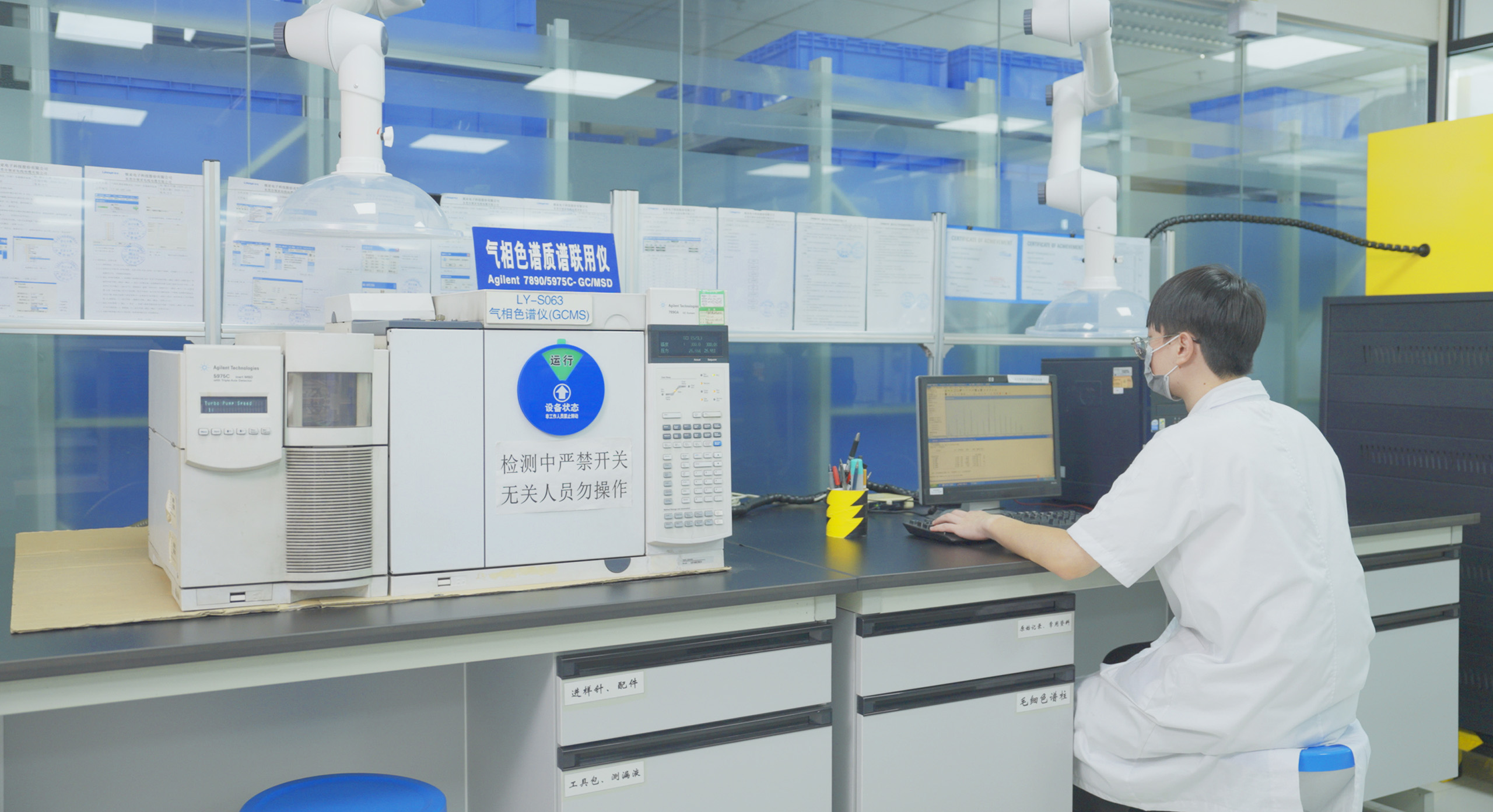
Electrical performance testing is performed before delivery. Factory test records confirm the cable left the plant correctly; site testing after construction remains the installer's responsibility.
Frequently Asked Questions
Which certifications and standards should an outdoor waterproof Ethernet cable meet for EU and Middle East projects?
Start with three layers. Transmission performance should follow TIA/EIA-568-C.2, with EN and GB standards applied where the regional project requires them. Flame rating should match the installation route — CM/CMG, CMR or CMP. For EU construction works, the cable also needs a CPR performance classification, and buyers should request the Declaration of Conformity and the per-SKU test evidence rather than accepting a company-level certificate. The Linoya network cable range is certified to UL, ETL and CPR and complies with TIA/EIA, EN and GB standards, which is the document set to verify against the exact model on your purchase order.
Can an outdoor waterproof Ethernet cable be manufactured in the category and shield type my project requires?
Yes, provided the supplier covers the full construction matrix. Linoya manufactures Cat5e, Cat6, Cat6a, Cat7, Cat7A and Cat8 network cables in unshielded, overall foil, screen plus foil, individual pair foil and overall plus pair foil constructions, using 24AWG, 23AWG or 22AWG solid bare copper depending on the model. Jacket options include PVC and LSZH, and the company works with a thermoplastic polymer portfolio covering PVC, CTPE, TPE, TPU, PUR, XLPE, XLPO, LSZH and FPE. The connector side is supplied as well: outdoor waterproof cables and connectors and outdoor smart connection and transmission solutions are part of the product range.
What drives the cost of an outdoor waterproof Ethernet cable?
Five variables move the price more than anything else: conductor type and gauge, shielding construction, jacket compound, flame rating testing, and certification testing. A 22AWG solid copper fully shielded construction costs more than a 24AWG unshielded construction, and a CPR-classified CMP cable costs more than a CM/CMG cable because of the test burden behind the rating. The comparison that matters is total installed cost, not unit price — the labour cost of replacing a failed outdoor run typically exceeds the price difference between an under-specified cable and a correct one.
Can samples be provided before mass production?
Sampling is normal practice for outdoor cable projects, because the two things that cannot be judged from a datasheet — connector fit and field installation behaviour — are exactly what a sample reveals. When you request a sample, specify the category, shield type, conductor gauge, jacket compound, length and whether the sample should be a bulk length or a pre-terminated assembly. Linoya factory-tests all finished cables for electrical performance before delivery. To request a sample or a specification review, contact the team at inquiry@linoya.com.
What lead time can be planned for a large outdoor cabling program?
Lead time is a function of the construction ordered, the jacket compound, the certification documentation required and the order volume. What can be evaluated in advance is whether the supplier has the capacity to absorb it: Linoya's annual production capacity reaches 4,000,000 kilometres of cable and wire, supported by a 60,000 m² manufacturing facility and more than 3,000 staff, which is designed for recurring and long-term cable supply programs. Send the bill of materials and required delivery dates through WhatsApp or email and the schedule can be confirmed against the specific configuration.
Conclusion: Specify the Construction, Then Choose the Supplier
An outdoor waterproof Ethernet cable is not defined by its category label. It is defined by solid bare copper conductors, a jacket compound intended for permanent outdoor exposure, a shielding system matched to the interference and surge environment, a connector interface that keeps water out, and a grounding and surge path designed as part of the installation. Get those five decisions right and the category choice becomes straightforward; get them wrong and no category rating will compensate.
That is also the framework for evaluating an outdoor waterproof Ethernet cable manufacturer. Look for process ownership, engineering depth, full category and shielding coverage, connector scope, per-SKU certification evidence, export experience in your market, and the production capacity to hold a delivery schedule.
Next Step
Linoya Electronic Technology Co., Ltd. has manufactured cable and wire since 1997, including network cables and high-speed data transmission cables and components, outdoor waterproof cables and connectors, and outdoor smart connection and transmission solutions.
Send your outdoor cabling requirement — category, run length, shield type, jacket and connector configuration — and receive a specification review, sample arrangement and quotation.
Email: inquiry@linoya.com | Tel: +86-15602610696 | WhatsApp | www.linoya.com
Download the Linoya Electronic Technology Co., Ltd. product catalogue (PDF)
Have Questions or Need More Details?
Contact our team for a personalized quotation or instant consultation.
Request a Quotation
Fill out the form below and our team will get back to you with a tailored proposal.
WhatsApp Direct Chat
Prefer to chat in real-time? Message us on WhatsApp for instant assistance & quick answers.
- Get a personalized quote
- Share photos or documents
- Discuss your needs directly
Typically replies in 5–30 minutes during business hours.