
Ranked Ethernet Cable Deployments: Data Center, High-EMI, Edge
This ranking orders four Ethernet cable deployment scenarios by how completely a single cable specification can satisfy the requirements each scenario imposes at the same time: transmission rate over the installed distance, flame rating for the pathway, shielding against the local electromagnetic environment, and certification coverage that a project buyer or auditor can verify. The order is enterprise data center and high-density core network first, high-EMI commercial building projects second, industrial edge applications third, and office 10G construction fourth.
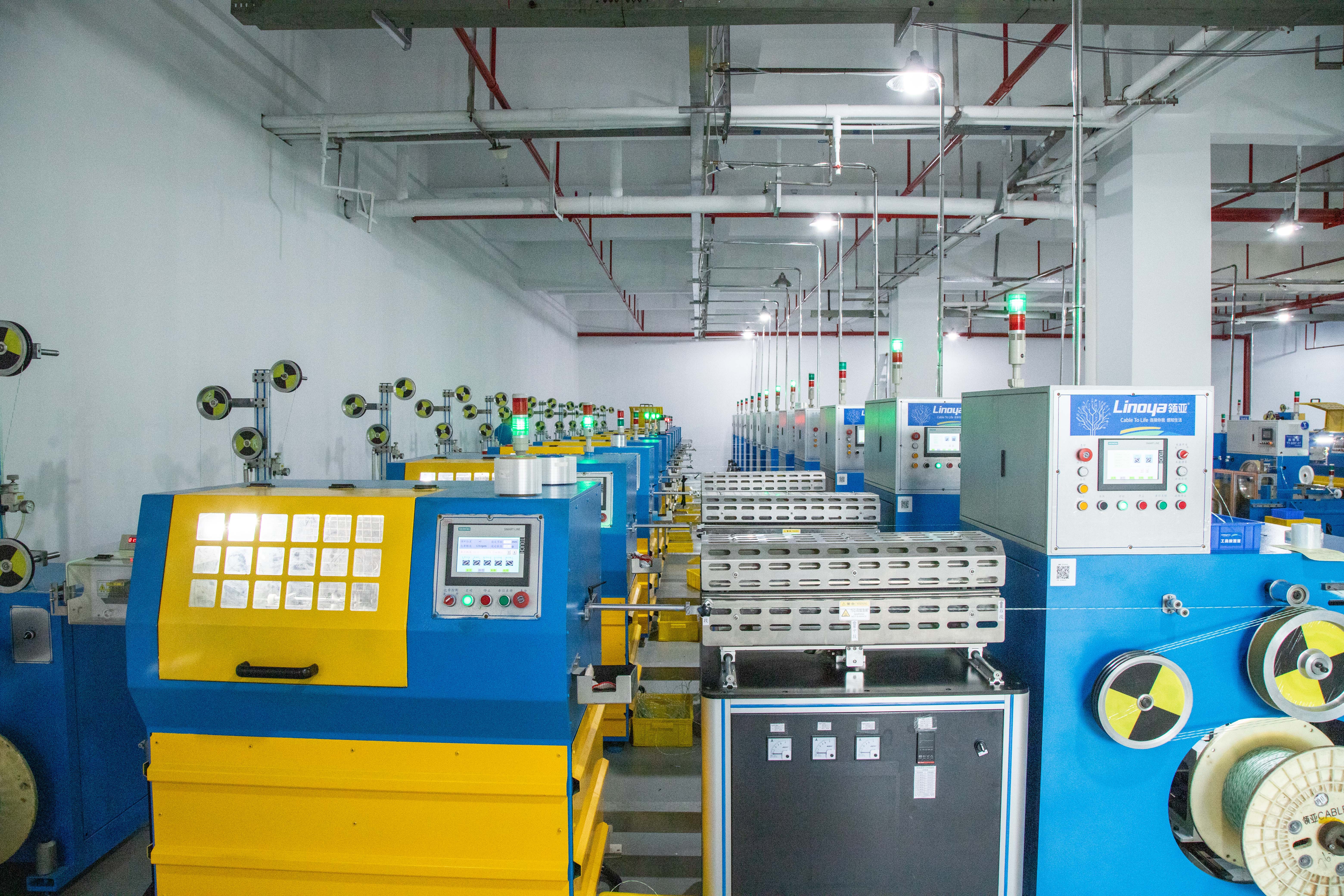
The sequence is an editorial fit assessment built from documented cable specifications, flame-rating scopes and certificate records published by Linoya Electronic Technology Co., Ltd., a cable and wire manufacturer established in 1997 with 60,000 m² of production space, 300+ engineers and an annual output of 4,000,000 kilometers. It ranks deployment scenarios, not brands, and it does not compare Linoya products against other manufacturers.
The problem with one cable specification across four duties
The same Ethernet cable category can be ordered for a data center cabinet row, a commercial riser and an office floor plate, yet the three positions do not test the cable in the same way. A buyer who selects on category alone ends up comparing Cat6, Cat6a and Cat7 as if they were interchangeable grades, and then discovers after installation that the flame type does not match the pathway, that the shield is not grounded, or that a 10Gbps link only reaches 55 m. Ranking deployment scenarios first reverses that order of work: the scenario defines the constraint set, and the constraint set defines the acceptable cable.
What the ranking measures
Four criteria are applied in the same order to every scenario, so the ranks reflect constraint density rather than product quality.
- Simultaneous constraints. A data center link must meet rate, flame and duty requirements at once, while an office link usually trades rate against cost. The more constraints that must hold together, the less room a buyer has to substitute a lower cable class.
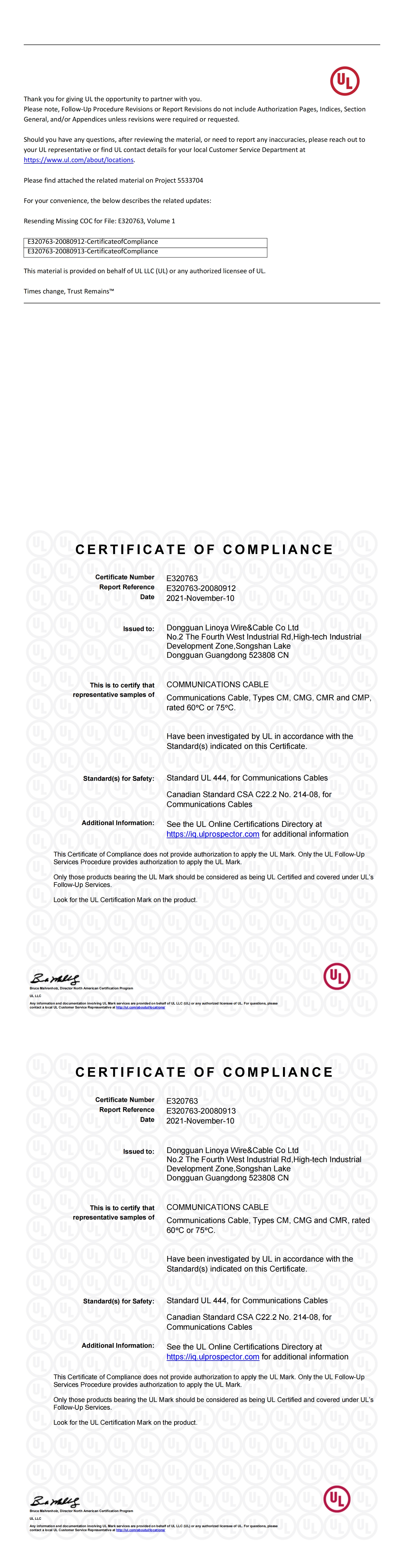
- Fire rating and certificate scope. The flame type marked on the cable has to appear in the scope of the certificate the project accepts. The UL Certificate of Compliance E320763 issued by UL LLC covers communications cable Types CM, CMG, CMR and CMP rated 60 °C or 75 °C to UL 444 and CSA C22.2 No. 214-08.
- Electromagnetic environment. Foil or braid shielding changes cable behaviour in high-EMI space, but only when the shield is grounded correctly at the installation.
- Distance and ecosystem. Twisted-pair Ethernet sets a 100 m maximum channel length including patch cords; Cat6 carries 10Gbps only up to 55 m, Cat6a to 100 m. Industrial edge adds a dependency on the switch and patch panel rather than on the cable alone.
Rank 1 — Enterprise data center and high-density core network
Enterprise data center deployments rank first because no other scenario imposes 10Gbps-or-higher transmission, CMP flame rating and 24/7 continuous duty simultaneously, across cable runs that are difficult to replace once the racks are populated.
Transmission rate sets the cable class
Rate is the first filter. For 10Gbps over a full 100 m channel, Cat6a is the starting class: the Cat6a U/UTP construction is documented in a small and medium data center rack-interconnection project with full 100 m 10G transmission, zero packet loss, CMP flame rating and passing data center acceptance. Where crosstalk margin matters more, Cat6a U/FTP with individually shielded pairs is documented for enterprise server-room 10G backbones with eliminated crosstalk, and Cat6a SF/UTP adds further shielding for high-density cabinet rows and enterprise core links.
Above 10Gbps the cable class rises and the working distance falls. Cat8 F/FTP with 22AWG solid copper is documented for cabinet-to-cabinet short-reach interconnection at 40Gbps over a 30 m transmission distance, with 99.998% network stability recorded for that deployment. Cat7A F/FTP is documented for 100Gbps short-reach links in premium data centers, using 22AWG heavy-gauge copper for minimal signal loss, and Cat7 F/FTP with 23AWG solid copper is documented for 40Gbps server interconnection with low attenuation. These are short-reach classes; they are not substitutes for a 100 m 10G channel.
Flame rating and certificate scope
CMP is the rating recorded across the data center case records, and the UL file scope confirms that the listed communications cable types run from CM through CMG and CMR to CMP. For EU projects the CPR classification for Cat6, 6A, 7, 7A and 8 S/FTP cable is B2ca-s1a,d0,a1 under EN 50575:2014+A1:2016, certified by TÜV Rheinland InterCert Kft. (Notified Body 1008) under certificate 1008-CPR-MC 69267303 0001. A US flame-type listing and an EU reaction-to-fire class on the same shielded family is what allows one cable specification to be carried from a tender document into both markets.
24/7 duty and what it changes for the buyer
Continuous duty is a property of the link rather than the jacket. Twisted-pair Ethernet is a passive transmission medium: the cable carries signal as long as the switch port stays energised, so the documented operating mode for these deployments is 24/7 high-load continuous operation with passive signal transmission. The buyer's real risk therefore sits in insertion loss and attenuation margin over the installed length, not in a duty-cycle figure printed on the reel. That is why the data center ranks first: an undersized conductor or a lower category appears as link margin loss that no amount of re-termination will recover.
Rank 2 — High-EMI commercial building projects
High-EMI commercial building projects rank second. Interference is the dominant variable and shielding addresses it directly, but the rate requirement is usually lower than in a core network and the flame rating depends on where the cable runs.
Shielding selected in steps
Cat5E F/UTP applies foil shielding to office horizontal cabling and conference-room systems where general EMI is present, and is recorded with CM/CMG flame rating and UL/ETL certification for reliable Gigabit transmission. Cat6 F/UTP applies foil shielding to commercial vertical cabling, hotel room networks and offices with moderate EMI, recorded with CMR flame rating, UL/ETL certification and consistent high-speed performance. Cat6a SF/UTP adds enhanced shielding for high-EMI commercial buildings and enterprise core links, and is documented for stable 10G transmission in high-density environments with an LSZH jacket available as an option.
CM/CMG and CMR: match the rating to the pathway
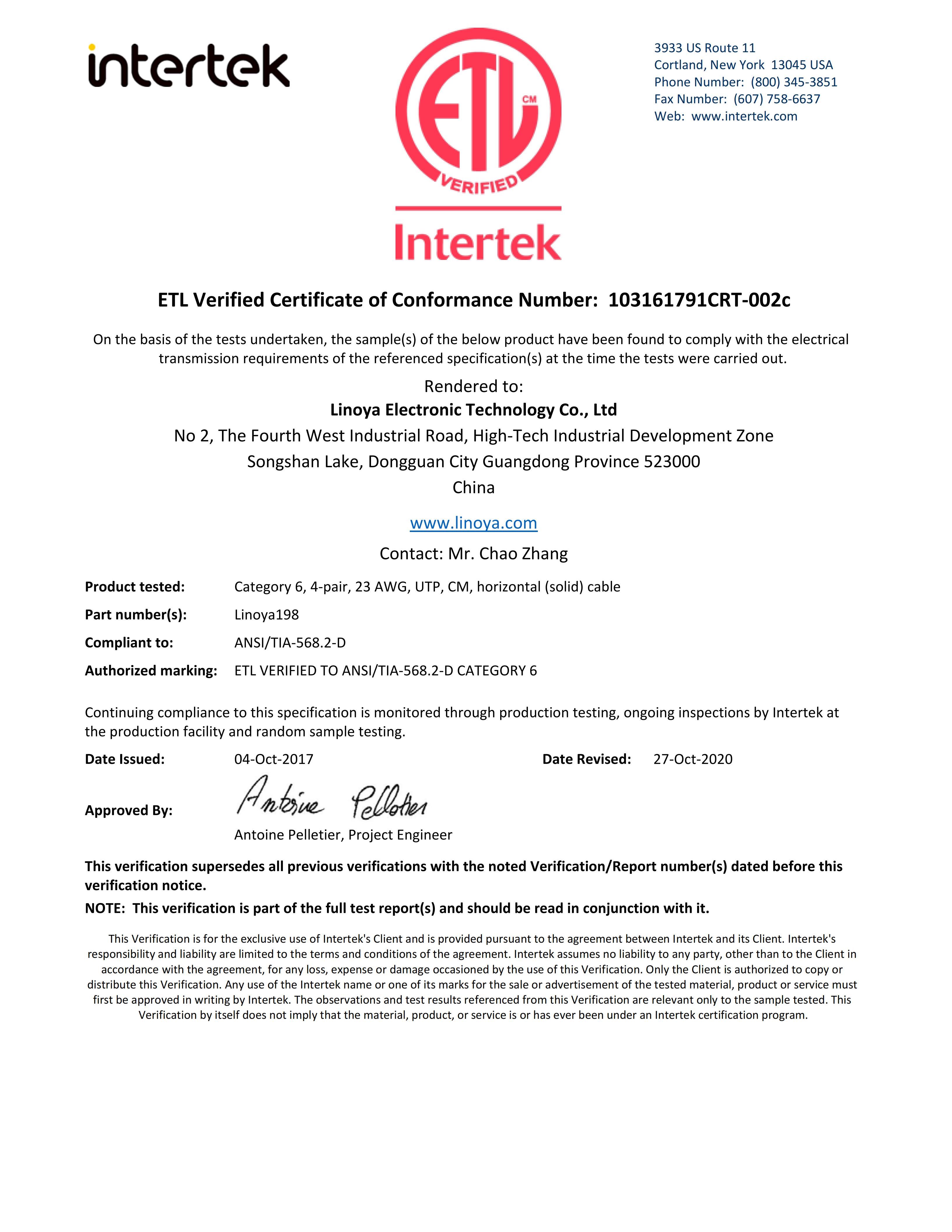
The flame rating follows the pathway rather than the building type. A run through a general commercial space commonly carries a CM or CMG rating; a run through a riser calls for CMR. The ETL verifications show how narrowly the scope is drawn: certificate 103161791CRT-002c covers Category 6, 4-pair, 23AWG, UTP, CM horizontal solid cable (part Linoya198) to ANSI/TIA-568.2-D, and certificate 3168693CRT-004c covers 4-pair 24AWG FTP CM non-plenum horizontal solid cable to ANSI/TIA-568-B.2 Category 5e. Neither document covers a plenum run.
One detail matters when documents are compared. The ETL verification for Category 6A U/FTP, certificate 102500029CRT-002, records the construction to ISO/IEC 11801-1 but states “No flame rating” in its scope. That does not make the cable unusable; it means the flame type for a rated pathway must be evidenced by the document that actually covers it, in this case the UL listing spanning CM through CMP. Matching a certificate's scope to the flame type named in the specification is the most common document gap in commercial tenders.
EU commercial projects: certificate, not report
On the EU side the same principle applies at CPR level. A laboratory test report does not replace a formal CPR-CE certificate issued by an EU Notified Body for customs and tender purposes; the certificate serial number should be verified on the issuing body's website, and the product-model coverage should match the cable being supplied. Linoya's CPR documents are issued by authorised Notified Bodies including TÜV Rheinland (1008), EZÚ (1014) and VDE (0366), across Eca and Dca classes for Cat5E, Cat6, Cat6A and Cat7 constructions. Shielding also carries an installation condition: a shielded cable with an incorrectly grounded shield can behave worse than an unshielded one in the same space, so patch panel grounding and shield continuity belong in the specification.

Rank 3 — Industrial edge applications
Industrial edge applications rank third, not because the cable duty is lighter but because the cable alone does not determine the result. The same shielded construction that stabilises a commercial riser also works on a factory floor, provided the switch, patch panel, connectors and grounding are specified to the same standard.
Equipment pairing defines the cable duty
An industrial automation backbone built around industrial Gigabit switches, PLCs, industrial robots, control systems and sensor networks calls for full shielding and an industrial-grade jacket; the documented requirement for that scenario is a CMP-rated, UL/ETL/CPR-certified, fully shielded construction with an LSZH jacket. A mixed industrial park or factory office network built around an industrial switch, core switch, patch panel, industrial control equipment and workstations has a lower rate requirement and is documented with CMR-rated shielded cable instead.
Cable choices by edge duty
Selection follows rate and interference level together. Cat6a F/FTP with a full shielding structure is documented for heavy industrial automation networks and production-line wiring, carrying 10Gbps in extreme EMI environments with CMP flame rating, CPR certification and an optional LSZH jacket. Cat7 F/FTP is documented for factory automation backbones at 40Gbps in strong EMI, with PoE++ performance recorded for the same construction. Where the edge is an office rather than a production line — an industrial park office or a factory office next to high-noise equipment — Cat6a SF/UTP with optional industrial grade and CMR rating, or Cat5E SF/UTP for a noise-exposed office at Gigabit rates, is the proportionate choice.
Three limits that belong in the decision
- Flame rating does not disappear because the location is industrial. If the cable enters a cabinet or a room covered by a building code, the rating requirement follows it.
- Termination quality decides whether the shielding performs. Factory-tested cable still needs an on-site re-check after construction, and a bent or broken RJ45 pin cannot be straightened back into specification — the connector has to be replaced, or a factory-assembled patch cord used instead.
- LSZH claims need documents. Genuine low-smoke zero-halogen cable should be supported by a CPR fire-class certificate and material test records, not by the supplier's description alone.
Rank 4 — Office 10G construction
Office 10G construction ranks fourth because it carries the fewest simultaneous constraints: interference is usually moderate, runs are shorter, and cost is the binding variable. The compliance requirements are still specific, and skipping them is what turns a 10G upgrade into a Gigabit network with a 10G invoice.
CMR, UL/ETL and the rate limit
For an office fit-out the flame rating is normally CMR for riser runs and CM/CMG for horizontal runs. The Cat6 U/UTP construction is documented for commercial office 10G builds, SMB highspeed upgrades and retail deployment with CMR flame rating, PoE++ support, dual 24AWG/23AWG options and a passed 10G network performance test. Cat6 F/UTP is the alternative where moderate EMI is present in the same building, recorded with foil shielding, CMR rating, UL/ETL certification and consistent highspeed performance. Cat5E U/UTP remains the basic-wiring option for Gigabit offices, small-business networks and IP camera systems, with UL/ETL certification and TIA/EIA-568-C.2 compatibility recorded for it.
The rate limit is the part buyers most often miss. Cat6 carries 10Gbps only to 55 m; beyond that the channel needs Cat6a for a full 100 m 10G run, and the 100 m figure includes patch cords at both ends. On a floor plate with long horizontal runs to a distant telecom room, the cost difference between Cat6 and Cat6a is smaller than the cost of re-pulling the cable.
Dual 24AWG/23AWG options and TIA/EIA-568-C.2 compliance
The dual 24AWG/23AWG option is a procurement decision, not a preference. Conductor gauge affects insertion loss on the link, so the AWG value belongs in the purchase contract and on the datasheet rather than in a general description. The ETL scope for Category 6 UTP CM names 23AWG explicitly (certificate 103161791CRT-002c), while the Category 5E UTP CM scope names 24AWG (certificate 103161791CRT-002a). Where the project specifies TIA/EIA-568-C.2 compliance, that reference appears in the standards column of the relevant CPR classification reports — for example the EZÚ reports for UTP Cat6 LSZH in Dca-s1,d1,a2 and U/FTP Cat6a LSZH in Dca-s1a,d0,a2 cite CSN EN 13501-6:2014 together with TIA/EIA 568-C.2.
The four scenarios side by side
| Rank | Deployment scenario | Flame rating focus | Shielding | Rate and distance driver | Document anchor |
|---|---|---|---|---|---|
| 1 | Enterprise data center and high-density core network | CMP | U/UTP and U/FTP at 10G; full shielding on 40G and 100G short-reach | 10Gbps over 100 m; 40Gbps over 30 m on 22AWG Cat8; 100Gbps short reach | UL E320763 (CM–CMP); CPR B2ca-s1a,d0,a1 for Cat6–Cat8 S/FTP |
| 2 | High-EMI commercial building | CM/CMG; CMR for riser runs | Foil shielding through to enhanced SF/UTP shielding | Gigabit to 10Gbps over standard horizontal runs | ETL 103161791CRT-002c Cat6 UTP CM 23AWG; ETL 3168693CRT-004c Cat5E F/UTP CM; CPR Eca and Dca reports |
| 3 | Industrial edge | CMR or CMP depending on pathway | Full shielding in F/FTP and SF/UTP constructions | 10Gbps to 40Gbps with PoE++ support | Case records for Cat6a F/FTP at 10G and Cat7 F/FTP at 40G in strong EMI |
| 4 | Office 10G construction | CMR; CM/CMG on horizontal runs | U/UTP baseline, F/UTP where moderate EMI exists | 10Gbps to 55 m on Cat6, 100 m on Cat6a | ETL Cat6 UTP CM 23AWG; TIA/EIA-568-C.2 cited in EZÚ CPR reports; UL/ETL certification |
When the ranking changes
The order reflects constraint density, so it changes when a single constraint starts to dominate the decision.
- If a commercial building has no significant EMI source, foil-shielded Cat6 is sufficient and the office pattern applies instead of the full high-EMI specification.
- If an industrial edge link requires 100Gbps, the cable class moves into the data center group: Cat7A F/FTP with 22AWG copper is documented for 100Gbps short-reach links in extreme EMI environments.
- If a data center link is entirely short-reach cabinet-to-cabinet, Cat8 F/FTP at a 30 m transmission distance is the documented class and a 100 m channel is not the reference.
- If the office floor plate uses dense cable bundles or PoE++ devices, Cat6a replaces Cat6 even at short distances.
- Outdoor and underground runs sit outside this ranking entirely: indoor cable cannot be buried directly, and an underground deployment needs a direct-burial rated cable with a water-resistant jacket, preferably run inside protective conduit with sealed joints.
Verification steps that apply to every rank
Whichever scenario is being procured, the same five checks decide whether the certificate file supports the order.
- Confirm the UL file is active on the official UL website before ordering. The communications cable UL file E320763 is maintained as continuously active and covers Types CM, CMG, CMR and CMP rated 60 °C or 75 °C.
- Verify each CPR certificate serial number on the Notified Body's own website, and check that the certificate covers the model and fire class being supplied — a laboratory report is not a substitute at tender or customs.
- Match certificate scope to construction. ETL scopes name pair count, AWG, shielding, flame type and part number, so an unscoped claim of “Cat6a certified” proves very little.
- Ask for batch-consistency evidence: quality-control procedure, batch test records and previous large-volume export references. Linoya applies a 100% pre-shipment test, full electrical performance testing, random sampling inspection and third-party inspection through SGS or UL.
- For international projects requiring third-party audit, request the complete dossier — CPR-CE, UL and ETL documents together — rather than a single certificate extract.
Bulk supply parameters sit behind these checks: 305 m per carton, a 100-carton minimum order quantity, a 30-day lead time and a monthly capacity of 200,000 cartons, with export to the EU, US, Middle East, Southeast Asia, Australia, South Korea and Japan.
FAQ
Which flame rating should an Ethernet cable carry for a data center and for a commercial building?
A data center run normally sits inside a plenum or air-handling space, so the specification calls for CMP, and the cable family should show CMP inside the scope of a recognised listing — the UL Certificate of Compliance E320763 covers Types CM, CMG, CMR and CMP under UL 444 and CSA C22.2 No. 214-08. For commercial buildings the rating follows the pathway: CM or CMG for general horizontal runs and CMR for riser runs, with the ETL verification matched to the exact construction, for example Category 6, 4-pair, 23AWG, UTP, CM horizontal solid cable. A certificate that omits the required flame type from its scope does not satisfy the specification, even when the cable itself is capable of it.
Can one Ethernet cable type serve both a data center and an industrial edge deployment?
Not as a single specification. The data center requirement is driven by rate and flame rating: Cat6a for 10Gbps over 100 m, Cat7A or Cat8 for 40Gbps and 100Gbps short-reach links, with CMP rating throughout. The industrial edge requirement is driven by shielding plus the switch, patch panel and grounding that complete the link — a factory automation backbone is documented with Cat7 F/FTP at 40Gbps in strong EMI with PoE++ performance, while a factory office beside high-noise equipment is documented with Cat6a SF/UTP or Cat5E SF/UTP. The overlap between the two scenarios is the shielded Cat6a family, which is why it appears in both sets of records.
Is Cat6 U/UTP enough for an office 10G build?
Within limits. Cat6 supports 10Gbps up to 55 m; beyond that the channel needs Cat6a for a full 100 m run, and the 100 m limit includes the patch cords at both ends. The Cat6 U/UTP construction is documented for commercial office 10G projects with CMR flame rating, PoE++ support, dual 24AWG/23AWG options and a passed 10G performance test, so it is a legitimate cost-controlled choice on short horizontal runs. Cat6a becomes the requirement where the run exceeds 55 m, where cable bundles are dense, or where PoE++ loads are high.
What should a buyer check on a sample before placing a bulk order?
Check the conductor and the marking first: AWG, category, flame type and shield construction should match the datasheet, because conductor gauge affects insertion loss on the link and therefore belongs in the purchase contract. Then check the documents: the UL file should be active, and CPR certification should be a Notified Body certificate whose serial number can be verified on the issuing body's website rather than a laboratory report alone. Finally check the test record — a 100% pre-shipment test and full electrical performance test, with third-party inspection and random sampling available — and install a short sample run on site, since termination quality is confirmed in the field and not on the reel.
What MOQ and lead time apply to bulk Ethernet cable orders?
Bulk cable is quoted in 305 m cartons with a 100-carton minimum order quantity and a 30-day lead time, against a monthly capacity of 200,000 cartons. That capacity covers OEM and customisation work on cable length, logo printing and packaging, and after-sales support includes 24/7 online technical support, a 1-year product warranty and free replacement of defective products. Buyers comparing several scenarios in this ranking can review the full range in the Linoya company brochure before requesting a sample or a quotation.
Conclusion
Ranking deployments by fit rather than by cable category produces a different buying sequence. Data center work ranks first because 10Gbps-or-higher transmission, CMP flame rating and continuous duty have to hold together at once, and the certificate file has to prove it. High-EMI commercial buildings rank second because shielding solves the main problem but the flame rating still depends on the pathway. Industrial edge ranks third because the switch, patch panel and grounding share responsibility for the result. Office 10G ranks fourth because cost dominates, provided the 55 m Cat6 limit, the CMR rating and the TIA/EIA-568-C.2 reference are not skipped. Used in that order, the ranking turns a category list into a specification decision that survives both a tender review and a post-installation test.
Have Questions or Need More Details?
Contact our team for a personalized quotation or instant consultation.
Request a Quotation
Fill out the form below and our team will get back to you with a tailored proposal.
WhatsApp Direct Chat
Prefer to chat in real-time? Message us on WhatsApp for instant assistance & quick answers.
- Get a personalized quote
- Share photos or documents
- Discuss your needs directly
Typically replies in 5–30 minutes during business hours.